
This article appears in the October 2026 issue of The American Prospect magazine. If you’d like to receive our next issue in your mailbox, please subscribe here.
Read more Left Anchor: Occupy Wall Street Revisited
The Trump administration has spent the past two years asserting broad executive powers and privileges with little historical precedent: imposing tariffs, executing mass deportations, deploying the National Guard in American cities, , sanctioning law firms and universities, firing civil servants and watchdogs, removing foreign heads of state, calling in drone strikes on fishing boats, withholding grants to states and nongovernmental agencies, bending banking rules, brokering critical minerals deals, and speeding up federal contracting, with many of these enriching the president’s family and their circle. Some orders have been brazen and public enough to generate blowback in court. But the infrastructure underlying them has remained in place. In fact, it’s continued to grow through a little-scrutinized mechanism of the federal government: the interagency task force.
More from Zachary Groz
Around 50 years ago, in peacetime, with no urgent national security threat posed, no new foreign adversary defined, and no state of emergency declared, the federal government began deploying military-style joint task forces around the country. Their first target: bank robbers. A string of high-profile, multimillion-dollar heists had caught the New York City Police Department (NYPD) flatfooted, so in 1979 the FBI swooped in to help, bringing along the agency’s prosecutorial firepower and sophisticated intelligence.
What otherwise might have devolved into a turf war over jurisdiction became the basis for an extended collaboration. That summer, the feds and the police came together to sign a memorandum of understanding, agreeing to share records and on-the-ground informants, and they formed the Bank Robbery Task Force. The office operated on a simple principle. “Cooperation,” the task force , “is the backbone of effective law enforcement.”
It was the birth of what would later come to be called the “whole-of-government” approach to public safety and national security, breaking down more silos among federal, state, military, intelligence, and law enforcement agencies. A year later, the first Joint Terrorism Task Force (JTTF) was formed in New York, combining resources again from the FBI and NYPD. In 1982, the model expanded with the creation of the Organized Crime Drug Enforcement Task Forces, which would eventually bring together the Department of Justice, Department of Treasury, Department of Homeland Security, Department of Labor, Department of State, and the Postal Inspection Service under the same roof to build complex cases against transnational cartels and money launderers. After 9/11 and the signing of the PATRIOT Act, the feds took things even further, setting up hundreds of terrorism task forces across the country, expanding information-sharing between local police departments and federal agencies to include foreign intelligence officers.
In the last two years, the Trump administration has lifted those efforts to new heights, creating, expanding, and reconfiguring task forces across the federal bureaucracy, with vague and limited disclosure about what the interagency collaborations hope to achieve, without congressional approval or substantial limits imposed by courts. The task forces focus on the same idea: that the country is in the midst of an emergency, brought on by foreign “invasion” and domestic unrest, requiring the federal government to marshal all of its resources to take control of how states and cities govern themselves.
That was clear enough from the very start of Donald Trump’s second term. At a February 2025 conference in Columbia, South Carolina, then-Deputy Attorney General Emil Bove, now a federal appeals court judge, addressed an assembled crowd of leaders of what used to be called the Organized Crime Drug Enforcement Task Forces (OCDETF) and has since been rebranded through an executive order the Homeland Security Task Forces. He told them that from then on, the “gloves are off” for federal prosecutors, according to one former DOJ official. It was at that conference that Bove announced the administration’s new policy of bombing suspected drug boats in the Caribbean and Pacific instead of interdicting them, as had been the status quo. The new doctrine was justified, he said, to repel an “ongoing invasion” that the country was allegedly suffering. The Department of Justice did not respond to a request for comment.
That theory of unrestrained executive authority to deter purported public safety and national security threats has been tested on the ground in major American cities, leading to chaos, most notably in Portland, Los Angeles, and Chicago. Before those deployments, which months later were derailed on an ad hoc basis in the courts and voluntarily withdrawn by the administration, the president had laid the groundwork in the nation’s capital, establishing through executive order the D.C. Safe and Beautiful Task Force, which assembled six federal agencies and three U.S. Attorney offices in the name of not only “preventing crime, punishing criminals, [and] preserving order” but also “promoting beautification” through new monument projects like Trump’s planned triumphal arch, led by the Department of Interior. The effort began in earnest in August of last year,when the administration federalized the District of Columbia police department for 30 days and deployed thousands of National Guard troops, who are set to remain on the streets of the capital through at least the end of Trump’s term.
D.C.’s Democratic attorney general initially won a lawsuit challenging the deployment, but an appeals court late last year allowed it to proceed. Local officials had urged the administration to hold back on its boots-on-the-ground takeover, which they said they didn’t need, and, predictably, despite the overwhelming federal surge, the administration was only able to turn up a 20 percent increase in arrests year over year, most of them for low-level misdemeanors, by the end of 2025. Meanwhile, in the first eight months of 2025, before the task force took over, D.C. had already been outpacing its arrests from 2024 by 20 percent. Data from the first two months of the federal takeover give some indication of what the real purpose of asserting broad executive powers in Washington had been all along: 40 percent of the arrests were related to immigration enforcement.
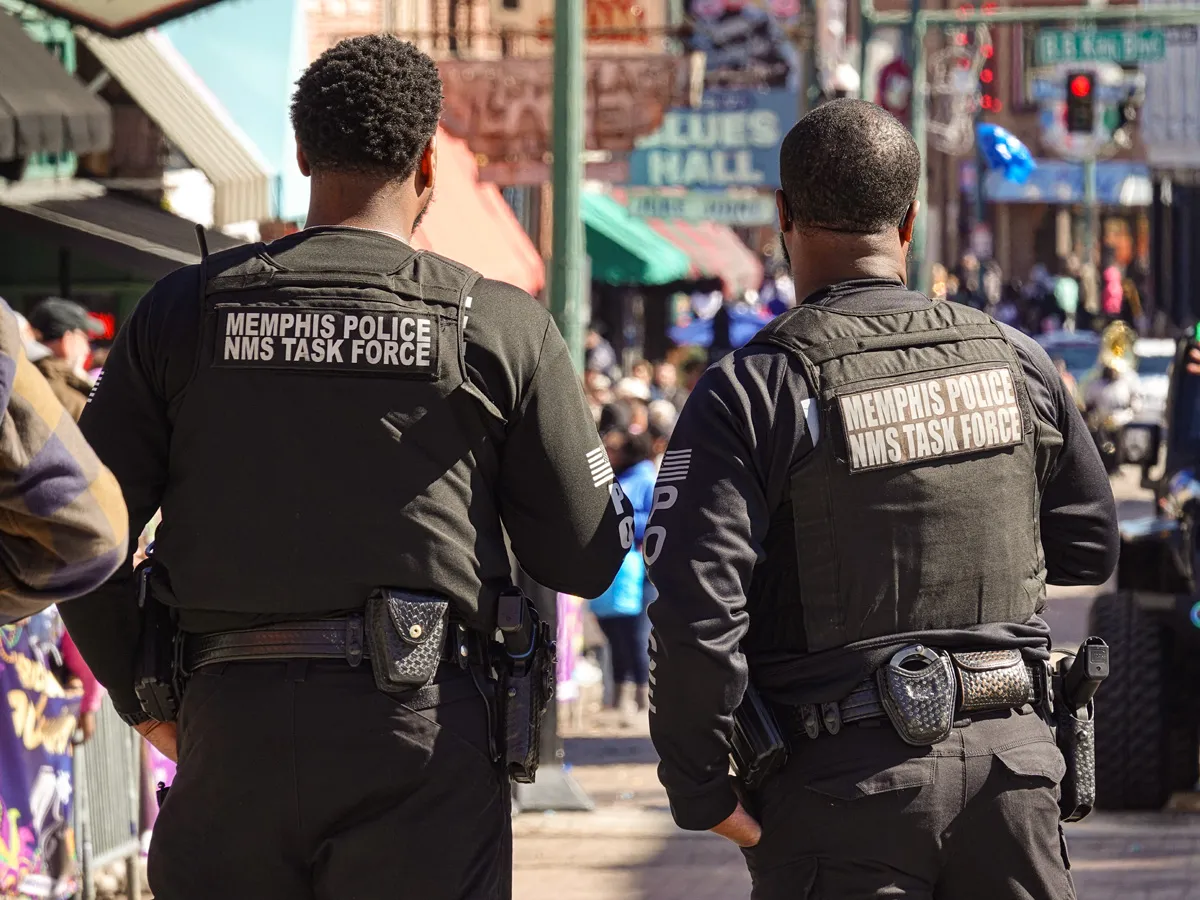
Beginning in September 2025, the administration took the same approach in Memphis, Tennessee, through its Memphis Safe Task Force, which assembled more federal agencies than even the D.C. effort—more than a dozen all told. In addition to bread-and-butter task force partners like DHS, FBI, and DOJ, representatives from the Department of Defense, Department of Health and Human Services, and Department of Housing and Urban Development were involved. The administration has not disclosed much about how it has deployed federal agencies in the city, despite requests from Rep. Steve Cohen, whose district includes Memphis. But their conduct on the streets has given some indication. Over the summer, a special agent from Homeland Security Investigations, the criminal investigative unit that coordinates with ICE, shot and killed a man while responding to a 911 call from his mother, who had said he was having a mental health crisis. A few weeks later, two National Guard soldiers, who had been called up nominally to patrol the city’s streets, shot and killed a 20-year-old man armed with a handgun, after chasing him on foot just before 4 a.m.
Read more Lock In, Losers. It’s Time to Vote.
The week before the Trump administration issued its executive order establishing the Memphis Safe Task Force, the local police department announced that the city had hit a 25-year low in overall crime, mirroring the situation in D.C. The feds were effectively positioning themselves to take credit for work that Memphis authorities had managed to do themselves, and had meanwhile dug themselves in to conduct “a sustained campaign” in a city where all major crime rates were falling fast. It would come to serve a broader purpose, Attorney General Todd Blanche testified at his confirmation hearing, “as a poster child of what we should do in cities across this country.”
The Trump administration’s use of interagency task forces had been raising concern among former Justice Department officials, who are familiar with the powers and resources available to them, for some time. “We should all be very concerned about the use of resources, the judgment calls being made in this administration, and with this Justice Department, and with this leadership about how they are spending resources and either using or abusing their authorities to focus on criminal activity, or in some cases, hoping to be able to find criminal activity where there’s really no indication of it existing,” said one former DOJ official.
One of the best examples is the Organized Crime Drug Enforcement Task Forces. For more than four decades, OCDETF had grown to become one of the biggest interagency collaborations in the federal government, equipping it with a cross-section of resources no single agency had on its own, and spreading out federal money across agencies to which Congress had not appropriated. “The OCDETF Fusion Center brought together many terabytes of data into one database, and so what we were able to do is fuse all of the investigative information from these various agencies, 24 different agencies, into a single sign-on, single-query database,” said the former DOJ official. That database has been capable of instantly pulling records from the FBI, IRS, Homeland Security Investigations, and the Treasury’s Financial Crimes Enforcement Network, which over the years has helped investigators unveil the financial webs tying together drug traffickers.
In the second Trump administration, the newly renamed Homeland Security Task Forces have been told to take a different approach, moving away from targeting organized crime syndicates to primarily focus on “smaller cases, criminal cases, and really more dominantly focused on doing immigration enforcement,” according to the former official. That became clear when early on, the administration “eliminated the requirement with the HSTF for doing financial investigations,” which formed the basis of the unit’s organized crime busts for at least a decade. The pivot in this and other task forces has led to the pursuit of charges for a host of low-level offenses, including small benefits fraud cases, nonviolent protesters, and noncitizen voting. According to a recent report by ProPublica, the latter has borne practically no fruit.
One initiative, the White House–led Government Transparency Task Force, has assembled officials from the office of the Director of National Intelligence (DNI), CIA, DHS, and the National Security Agency (NSA) to comb through intelligence community files for shreds of evidence of foreign interference in elections and a “deep state coverup.” Another, the Task Force to Eliminate Fraud, was established to prove spurious connections between state-run, federally funded benefit programs and “foreign gangs” and “terror groups.” Over the summer, that interagency program expanded to include its own fusion center, pooling resources from many non-law enforcement agencies that the administration has targeted for demolition since the DOGE days. The new fusion center is putting to work inspectors general, who’ve been ordered by the president to “identify fraud” and feed information to U.S. attorneys who will then “prosecute the most nefarious criminals, domestic and abroad.”
The goal of unleashing the overwhelming resources and data-mining capabilities of interagency task forces has been part of a larger pattern of breaking norms and pushing executive power to its absolute limit, even as the administration strips away the executive’s regulatory and public welfare roles. “This is an administration that exercises federal administrative power on steroids. It is anti-federalism. It is anti-separation of powers, and it is anti-restraint when it comes to using federal agencies on very skimpy statutory arguments to go out and do the political work that the administration can’t get through Congress,” said Richard Bernstein, a founding member of the Society for the Rule of Law, an advocacy group that submits briefs on consequential legal questions in federal court.
The administration’s assertion of an ongoing national emergency requiring the consolidation of federal resources and aggressive law enforcement tactics has put the courts in a difficult position. On the one hand, they’ve limited the administration’s most expansive claim that “the president’s decision that something is a national security issue is unreviewable,” said Jeremy Fogel, a former federal district court judge. But so far, restraining the underlying transformation of government has been out of reach. “The judiciary cannot manage the administration of federal agencies,” said Fogel. “Judges at every level are generally anxious to avoid questions they don’t have to decide.” For example, the administration’s most sweeping global tariffs may have been struck down, but its Trade Fraud Task Force, pooling together the investigative and prosecutorial resources of DHS and DOJ, remains in place.
That’s exposed an uneasy tension in the federal system. “There are a lot of authorities entrusted to the president specifically, or to the executive branch more broadly, that can be exercised, and there isn’t really a good mechanism for judicial review of them,” said Brian Frazelle, who serves as deputy chief counsel at the Constitutional Accountability Center, a legal think tank that’s been involved in lawsuits challenging the Trump administration’s executive power.
“It’s the same pattern of trying to exploit every opening that’s available, any chance to escape court review or limitations on what they want to do,” Frazelle said.
Read more Panicked Red-State Republicans Learning Politics on the Fly
This article appears in Oct 2026 Issue.