
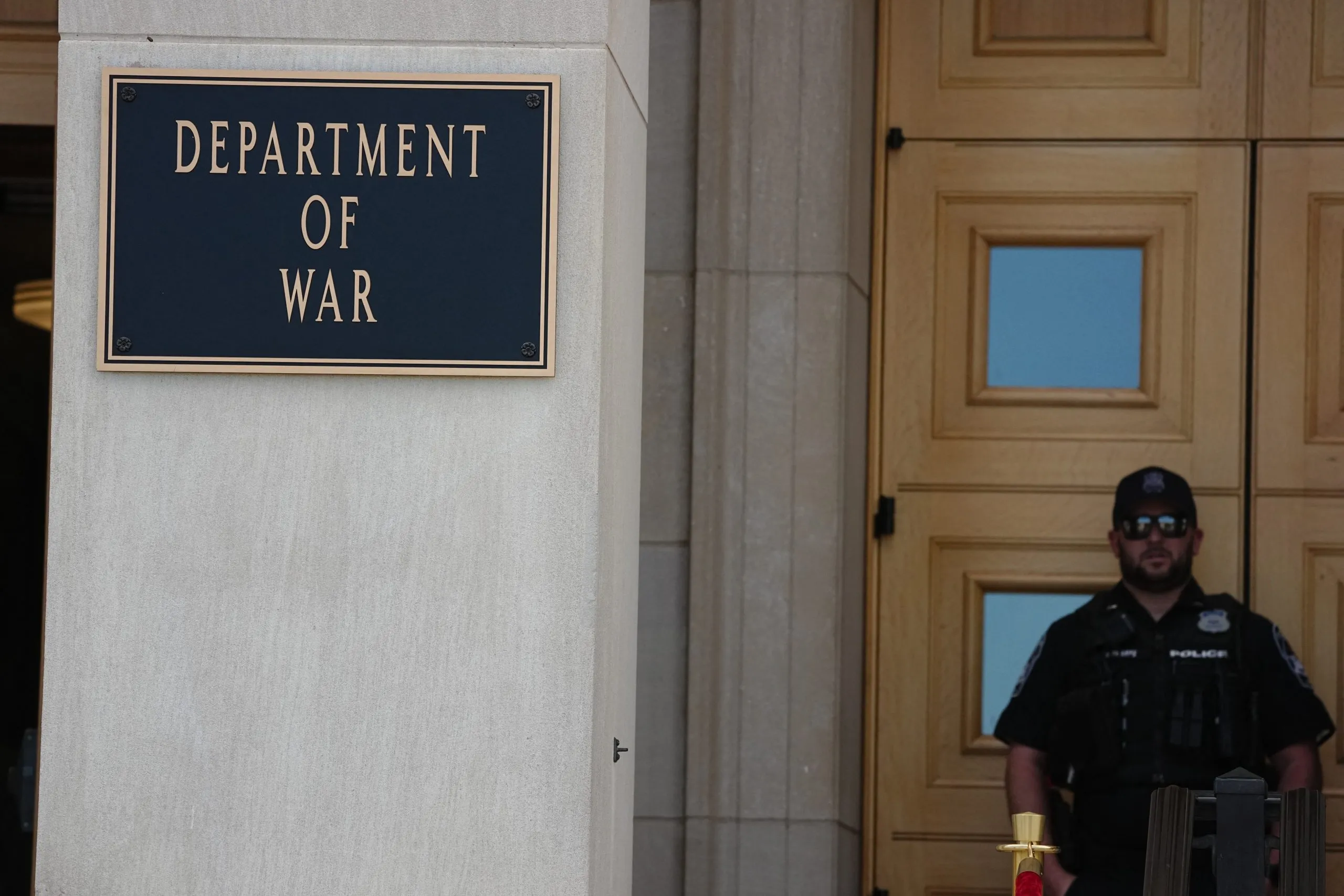
The Trump administration’s campaign to compel hundreds of billions of dollars of new military appropriations out of Congress, citing new materiel needs downstream of its unsanctioned Iran War, has been stalled in the Senate for months. But one unexpected winner has emerged from the congressional stalemate over defense spending: an obscure investment office in the Pentagon known as the Economic Defense Unit (EDU).
Read more The Sad Republicans Exploiting Family Tragedy
Earlier this year, Deputy Secretary of Defense Stephen Feinberg stood up the EDU and appointed George Kollitides, a one-time executive at Feinberg’s former private equity firm, Cerberus Capital Management, who recently was the subject of a ProPublica investigation for his role in steering a $350 million Department of Defense contract to a consulting firm where he was a partner until just weeks ago. The office was created by way of a memo from the deputy secretary, and has been operating without congressional authorization for months, taking center stage in the administration’s multi-billion-dollar effort to prop up domestic military and energy supply chains. Those deals have been heavily scrutinized for the ways they’ve favored well-connected Wall Street firms and have been set up to benefit the president and his inner circle.
The EDU, according to a source with knowledge of its strategy, operates as a “venture capital firm-type entity that looks at deals, what the government’s going to do and evaluates them, and determines, ‘Okay, what’s the government’s stake going to be in this, if any.’”
“You have analysis people in the Industrial Base Policy office that are doing all the analysis … and identifying these gaps that we need to fill,” the source said. “The EDU is layered on top of that to say, ‘Okay, well, if that’s the case, then what’s the government stake going to be?’ They don’t want to just give out grant money and that’s it. That’s the philosophy that the EDU has, and Mr. Feinberg in particular.”
In a draft of the National Defense Authorization Act (NDAA), the Senate Armed Services Committee gave some indication of how troubled Congress seems to be by this ongoing private equity-style transformation, which is to say troubled enough to acknowledge a problem exists but perhaps not moved to the point of solving it. The Armed Services Committee offered the Pentagon a deal of its own. It would strip the EDU of its ability to lead equity investments, giving the Office of Strategic Capital (OSC) the only express authorization to take stakes in private companies—something that has so far eluded it, though the office has been making those investments anyway.
And even OSC’s authority would be circumscribed. In exchange for being able to take private stakes legally, the head of the OSC would be barred from taking board seats at the portfolio companies, and would have to present a report on the ownership of a given company to Congress prior to finalizing an investment, a nod to the fact that these deals abound with conflicts of interest. It would also require the DoD to furnish all term sheets of the equity deals the Pentagon has made in the last two years, giving away the game that the details of those investments have received zero external oversight to date.
“They’re probably going to be not totally enthusiastic about the oversight that Congress is going to get and the restrictions Congress is going to place on them,” said the source familiar with the Pentagon investment offices’ thinking.
Read: The Pentagon buyout king
All other funding streams in the Pentagon besides OSC––hundreds of billions of dollars all told––would be off-limits for use in taking stakes in companies. But the Pentagon has gotten used to doing just that. Even in the months since the Armed Services Committee approved that draft bill, the Pentagon has made four new direct equity investments using funds from outside of OSC, totalling $775 million, all in critical minerals companies.
That committee draft of the National Defense Authorization Act (NDAA) passed with the support of four Democratic senators. For reasons mostly related to the 50 percent boost in overall funding, Democratic lawmakers blocked the package when it came to the Senate floor for a procedural vote back in July.
Read more It Should Be a Rescue Flight; Docs Show It Will Be Another Immigrant Expulsion
That means that Feinberg and his investment units at the Pentagon have yet to be compelled into budging on their approach and have been given the gift of time to continue executing on it.
But time, in this case, is not money, which Congress controls. Almost a full one-third of the budget boost the Trump administration has requested would go to “Defense Industrial Base” investments, most of them managed by those units, including the Pentagon’s Office of Strategic Capital, Economic Defense Unit, and Industrial Base Policy office.
This year’s for those offices is prodigious. Whereas , the administration asked for $300 million for the Office of Strategic Capital, this year it requested more than $20 billion. Last year, it asked for $2 billion to fund the Pentagon’s Industrial Base Analysis and Sustainment and Defense Production Act programs. This year, it asked for $70 billion.
Exactly what those offices would do with all that money is unclear. They have already taken center stage in the administration’s efforts to funnel billions of dollars into private companies in the military and energy supply chains, through low-interest loans and often with direct purchases of stock.
Though initially set up under the Biden administration to use federal financing tools to help small defense manufacturers get past prototyping and bring military-grade products to market, the Pentagon’s Office of Strategic Capital has in the last two years shifted to focusing on making substantial loans and taking direct equity stakes in rare earth mining companies. The office also helped broker the administration’s Venezuelan oil deal, ProPublica reported this week, directing how a new U.S. government-led energy venture would seat board members, and developing terms that “could not be undone by Trump’s successor.”
The administration’s messaging about the Office of Strategic Capital’s equity deals hasn’t exactly been consistent. Shortly before the OSC’s direct investment in the U.S.-led Venezuelan oil venture was announced, a Pentagon spokesperson told The New York Times that the office “does not take equity stakes in private companies.” The administration announced days later that the OSC had taken a “35% equity stake” in the venture.
Spokespeople for the Senate and House Armed Services committees declined or did not respond to requests for comment. A Department of Defense spokesperson wrote to the Prospect that DoD “values its longstanding working relationship with Congress” and is “working closely with the committees with jurisdiction to ensure the Department can continue to unleash the arsenal of freedom,” a phrase Secretary of Defense Pete Hegseth put at the center of a cross-country tour of defense manufacturers earlier this year, which he embarked on in the weeks before the U.S. and Israel launched joint strikes on Iran.
Read more Is Paris Burning?