
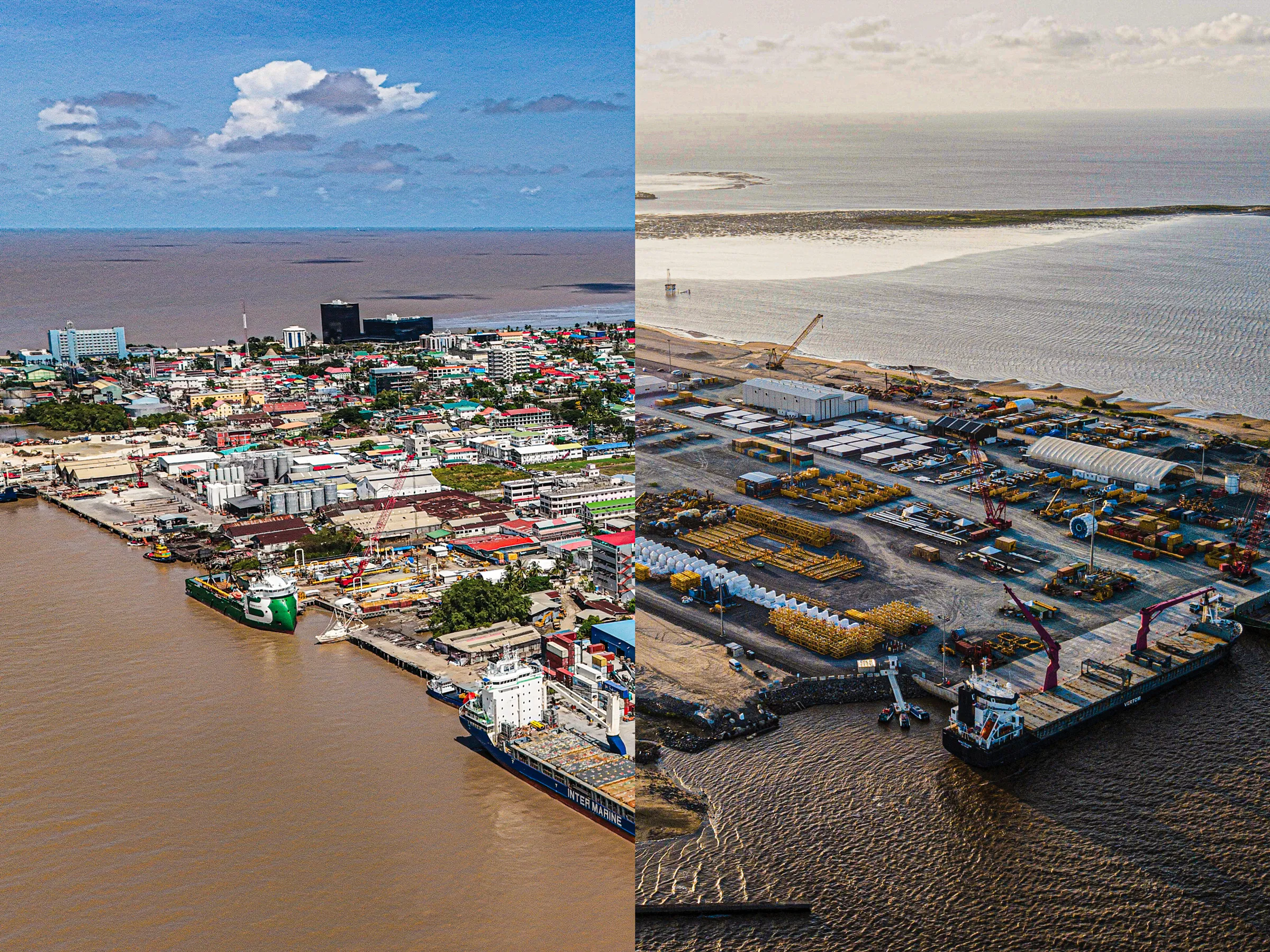
This article appears in the June 2026 issue of The American Prospect magazine. If you’d like to receive our next issue in your mailbox, please subscribe here.
Read more The Return of the Dixiecrat South
GEORGETOWN, GUYANA – It’s Saturday, and I’m squeezed into the back of a rickety red car on my way to the Mon Repos market. Getting there from Georgetown, Guyana’s capital, is straightforward: follow a highway that runs east from the city along the coast. I’m sitting beside my father’s cousin Rochelle, who has been incredibly helpful in getting us around, and a man named Gavin who’s been a taxi driver for decades sits behind the wheel. He tells me that despite having an old-age pension (a noncontributory social security benefit for Guyanese over the age of 65), he still loves doing this work.
After parking alongside the Rupert Craig Highway, we hold our breath just to cross the street as cars whiz by. At the market, the energy is palpable: Somewhere, a DJ is playing soca music while vendors stand behind stalls selling everything from freshly butchered pork to avocados the size of my hand. Guyana is the only country in the world that’s able to produce enough food to feed itself fully without relying on imported options. As I weave through the stalls behind Rochelle, whose hand is firmly clasped around that of her eight-year-old daughter, I see that reality. I reckon you could find any fruit or vegetable in the world here.
More from Naomi Bethune
Guyana is breathtaking. Around 85 percent of the country is covered in rainforest. Although it’s part of South America, its culture and language are aligned with English-speaking Caribbean countries. Guyanese people are racially and ethnically diverse, which reflects the influence of the United Kingdom’s century-plus of colonial rule, which ended in 1966. Indo-Guyanese, who are primarily descendants of Indian indentured laborers, constitute around 40 percent of the population. Afro-Guyanese, the second-largest ethnic group, account for nearly 30 percent, and are descendants of enslaved Africans who were kidnapped and forced to work on sugar plantations.
Although small in numbers, Guyana’s nine recognized indigenous nations (typically referred to as Amerindians) have had a significant impact on the country’s culture as well. Chinese Guyanese and Portuguese people have also long been active in business and commerce. Guyana’s overall population is around 850,000.
Located on the northern coast of South America, Guyana is squeezed between Venezuela and Suriname, with Trinidad and Tobago lying to the northwest. All three countries (especially Venezuela, which holds the largest crude oil supply in the world) have become more dependent on oil and gas in recent years. By contrast, Guyana’s most prominent natural resources had historically been bauxite, gold, sugar, and diamonds, but it too has seen the surging involvement of the fossil fuel industry.
Shell, ExxonMobil, and other oil companies operated intermittently in Guyana from the mid-1900s onward, drilling wells in hopes of finding crude. But it wasn’t until 2015, a couple of months after my last visit to the country, that Esso, a subsidiary of ExxonMobil, declared that over 295 feet of high-quality oil-bearing sandstone reservoirs were located off of Guyana’s coast. This was eventually drilled down to 17,825 feet. Over the past decade, ExxonMobil has made dozens of other discoveries in what is called the Stabroek Block, named after the historic name of Georgetown.
Crude oil prices are skyrocketing, an artifact of the broader war in Iran. That has paradoxically brought a projected windfall to multinational oil companies like ExxonMobil, but it has them searching for oil under every rock on Earth. In this environment, Guyana could become the site of another fossil fuel exploration boom.
Any country that partners with Big Oil can make billions through taxes, shared profit, and any royalties. In 2024, a Reuters investigation revealed that the three largest U.S. oil exploration companies paid more than $42 billion to foreign governments in that year alone. It’s not surprising then that a small country like Guyana, historically one of the most impoverished in South America, would want a slice of the pie. But reality has been less kind to the Guyanese people.
AS OF 2024, EXXONMOBIL CLAIMED that the Stabroek Block holds 11 billion oil equivalent barrels, and last November, the company said that 900,000 barrels of oil are produced daily. Amid the frenzy, environmental rights groups in Guyana and abroad have raised concerns about the heightened risk of oil spills.
ExxonMobil holds the majority ownership (45 percent) under its subsidiary ExxonMobil Guyana Limited. Hess (acquired by Chevron in July 2025) maintains 30 percent, and the Chinese National Offshore Oil Company (CNOOC), a venture owned by the People’s Republic of China, owns 25 percent. In 2016, the Stabroek Block Production Sharing Agreement (PSA) was signed by the Guyanese government and the aforementioned oil companies. It was kept under wraps until 2017, when after considerable pressure it was finally publicized.
The turned out to be one-sided. Up to 75 percent of the monthly gross revenue from the Stabroek Block covers ExxonMobil, Hess, and CNOOC’s operating and development costs. What’s left is split evenly between the companies and the government, meaning that Guyana gains a 12.5 percent revenue share. But this is only after “recoverable contract costs” are deducted from the leftover 25 percent.
Compared to other agreements, Guyana’s deal is particularly unfair. Guyana receives a fixed 2 percent royalty every quarter from the oil companies, which comes out of their respective profit shares, compared to the global average range of 10 to 15 percent. A report produced by Kaieteur News, a prominent Guyanese newspaper, in 2019 revealed that out of 130 PSAs, Guyana and ExxonMobil’s was the most “unusual.”
Out of Guyana’s share of the profits, the country pays the contractor’s income tax, and there is no sliding scale for the 2 percent royalty to increase as production evolves. Ring-fencing provisions were also omitted, which permits ExxonMobil and its counterparts to charge Guyana for the cost of newer wells before production even starts, if it starts at all.
Guyana received $2.1 billion in profits plus the additional royalty in 2024. The government waived $525 million in income taxes for ExxonMobil, which is built into the 2016 PSA: Oil companies are exempted from most income taxes. Instead, the Guyanese people pay annual taxes. ExxonMobil walked away from Guyana with $4.7 billion in profits; Hess saw $3.1 billion; and CNOOC reaped $2.5 billion.
The 2016 deal was created and signed in June, just slightly over a year after ExxonMobil announced its first oil discovery. In 2019, production started. This is accelerated compared to the process in other countries. “The reason why it takes so long elsewhere is because the oil industry is a well-regulated industry in most parts of the world,” says Thomas Singh, a senior lecturer in the University of Guyana’s Department of Economics. “In Guyana, on the other hand, we didn’t have the regulatory framework. Beyond that, we were so anxious to facilitate ExxonMobil that we allowed Exxon to lead the process. Exxon began to essentially regulate itself. That’s why it happened so fast.”
For years, scholars, politicians, and citizens alike have been calling for the “sweetheart” deal to be renegotiated to better favor Guyanese interests. In recent years, the Guyanese government has passed legislation aimed at improving regulations on oil and gas. In 2023, the Petroleum Activities Act superseded ancient regulatory frameworks, ensuring that any future oil agreements would better benefit the country. It includes ensuring a higher royalty rate (10 percent compared to the 2 percent that is outlined in the deal with ExxonMobil), a lower cost recovery ceiling (65 percent), and a 10 percent corporate tax. Guyana also established the Natural Resource Fund in 2019, which manages oil revenue. But the 2016 PSA remains in place.
Concerns remain about the dangers of the Guyanese economy’s reliance on the oil sector.
“I think the fear that economists have is that the boom and the bust in the commodity markets have corresponding effects on our economy,” says Singh. “The entire economy becomes dependent on oil, and the so-called Dutch disease phenomenon becomes very likely. We can see that already happening, and countries that export oil are particularly vulnerable to the Dutch disease.”
Named after the Netherlands’ economic troubles after the discovery of gas deposits in 1959, “Dutch disease” refers to how the increase of one natural resource sector (in Guyana’s case, oil and gas) reduces the competitiveness of the rest of the economy. It’s befallen countries such as Nigeria, Angola, and Venezuela, impacting economies already shaped by the legacy of colonial exploitation.
Guyana may fall victim to the resource curse as well.
IN THE MON REPOS MARKET, both Indo- and Afro-Guyanese are buying and selling around me. But one vendor tells me that despite this diversity, there isn’t much community. His name is Leon, and we chat behind his stall where he and his son sell a variety of fruits and vegetables. I haven’t asked any direct questions about race and racism, which has long been a significant factor impacting every element of Guyanese society, but I don’t have to.
“Guyana is about race,” Leon says frankly. “You can be a Black person, and no Indian will vote for you. You can be an Indian, and someone Black won’t vote for you.” He’s not wrong. Guyanese politics have long been racialized, with the two historically dominant political parties being split along ethnic, racial, and ideological lines. Called the People’s Progressive Party (PPP/C) and the People’s National Congress Reform (PNCR), the former has attracted the support of Indo-Guyanese, and the latter Afro-Guyanese.
“I believe we could be a model [of national cohesion], but not until we get a level of inclusion instead of a very narrow partisan approach on both sides,” says Mark Kirton, retired director of the Institute of International Relations at the University of the West Indies. “Historically, we’ve been beset by the fact that there’s a strong correlation between race and political preference, which is only now kind of moving forward based on disillusionment with parties … there’s national-interest issues that must be placed in the forefront.”
Several other parties have strong influence in the Guyanese parliament, some of which are multiethnic and multiracial, such as We Invest in Nationhood (WIN). A Partnership for National Unity (APNU) has also been a major player, whose advocates are predominantly Afro-Guyanese. It was an APNU–Alliance for Change (AFC; a multiethnic party) coalition-led government that signed the 2016 agreement with ExxonMobil. Now, the ruling party is the PPP, led by President Irfaan Ali, who is serving his second term. Ali has admitted that “we did not have the best of deals” with ExxonMobil in the past, but has not budged when faced with calls to renegotiate it.
Read more Aftermath: Something Is Going to Snap
ExxonMobil and Chevron’s statuses as U.S.-owned companies have resulted in the U.S. paying an increased amount of attention to Guyana. Recently, the U.S. ambassador to Guyana, Nicole Theriot, said that “it is incredibly dangerous to start talking about renegotiation of a contract that has been agreed upon. That sends a terrible signal to international investors all over the world that you can’t trust what you have signed with a government that is willing to renegotiate.” It was a typically aggressive ultimatum to an emerging market: Multinational corporations must be given whatever they want, so as not to spook investors.
Unsurprisingly, ExxonMobil has never shown interest in making changes to the Stabroek Block PSA. The Prospect reached out to ExxonMobil for comment, and didn’t receive a response.
It’s not the first time the U.S. has attempted to exert its influence over Guyana. Before the country gained independence in 1966, a covert CIA operation (with the support of British officials) successfully overthrew Cheddi Jagan, the first elected prime minister, whose party (the PPP) embraced leftist ideals and called for organizing across racial and ethnic lines. Forbes Burnham established and led the PNC with the support of the U.S., finally becoming the first prime minister of independent Guyana. He led the country for the next two decades, exerting what some consider an authoritarian rule, which also contributed to solidifying racial/ethnic political divides.
Venezuela’s position as Guyana’s next-door neighbor is a crucial component of America’s current geopolitical relationship with the country. Since the 19th century, Essequibo, Guyana’s western region, has been the subject of a significant territorial dispute. Tensions between Guyana and Venezuela pertaining to who has claim to the Essequibo have existed for decades, but in 2023, things reached a breaking point when the Venezuelan government declared that the results of a referendum showed overwhelming support for annexation.
This led to increased U.S. military assistance to Guyana, upping aid that started in 2022 and engaging in collaborative military exercises with the Guyanese army (which still continue to this day, as the Prospect confirmed with the U.S. Southern Command), military financial support, and further diplomatic meetings. Guyana’s wealth of natural resources, particularly the oil off its northern coast, arguably has influenced U.S. interest in the dispute, due to ExxonMobil’s operations in that area.
Later this year, the Essequibo dispute will be decided by the International Court of Justice. Guyana has requested that the court declare that Venezuela has no legitimate right to the region. In the meantime, the situation remains strained. “I think that this border dispute in Essequibo will only go away if the government in Guyana changes,” says Tamanisha J. John, an assistant professor of politics at York University. “Not just that the government changes, but the government changes and tries to pursue more cordial relations with Venezuela, and also tries to renegotiate its oil contract with ExxonMobil. I think that that’s going to be very hard for any new government in Guyana to try to do given how much power ExxonMobil has been able to amass in Guyana within the past four or five years.”
In 2025, Marco Rubio visited Guyana, and pledged that the U.S. would continue to provide support to the country, placing an emphasis on the oil industry. When Venezuelan President Nicolás Maduro was kidnapped by U.S. forces in January, Ali said it would bring “greater stability” to the region. Guyana, alongside Trinidad and Tobago and the Dominican Republic, was selected to attend the inaugural Shield of the Americas Summit hosted by President Trump in March.
WE HEAD OVER TO STABROEK MARKET in Georgetown, the city’s largest and oldest market. It’s difficult for me to find my way around. I’m sidestepping buses and motorbikes that are dangerously close to my feet. The clock tower, a Georgetown landmark, overlooks the hustle and bustle. A woman named Samantha is selling cleaning supplies. She repeats a complaint I’ve heard several times today: Guyana is too expensive.
“Every day people are just raising things, because the cost of living is really high. People are really underpaid. I think everybody needs more money,” she says. Through the Natural Resource Fund, the Guyanese government has begun to issue cash grants to citizens over the age of 18. After registering online, showing identification, and if necessary, opening a bank account, people are eligible to receive 100,000 Guyanese dollars. That shakes out to just shy of $500.
To many, that doesn’t help much. Inflation, largely due to the booming oil and gas industry, has created an environment of uncertainty. Although inflation overall has remained stable, the costs of food and housing have risen, leaving many of the Guyanese people I spoke with both angry and worried.
“We don’t notice the sense of frustration and humiliation people feel when you encounter these kinds of things in the market, where the money you come with won’t go as far as it went a couple of weeks ago,” says Mike McCormack, who sits on the Guyana Human Rights Association’s board of trustees. “When there’s something you can’t buy, you feel frustrated, but you don’t know what to do about it, because it’s inflation, it’s oil and gas and issues which are way above what you can cause and calculate. It builds up and it renders people more disposed to react.”
Compared to the current cost of living, many people don’t see the cash grants alone as being sufficient. I speak with a woman who’s selling grapefruit; her son peeks out from underneath the table as we talk. “Salary is the biggest headache in this country,” she says. “As long as you’re not getting a proper salary, nothing’s going to move forward … Things will always be the same way, and that’s what people are crying out all the time.”
In 2022, the World Bank said that Guyana’s poverty rate was one of the highest in South America, despite its rapidly growing GDP. Today, the current median monthly salary is $95,000 Guyanese dollars, which is less than $500.
Trickle-down economics could possibly become an issue in Guyanese society, Kirton reflects. “There’s a lot of infrastructure work going on on roads and bridges, but the average worker is not benefiting … the building activity is benefiting a small group,” he says. “We don’t get the kind of movement where people are satisfied.” I certainly could see evidence of that claim as I picked my way through both markets. Yet not a single person I spoke to was willing to directly speak about the government’s role in perpetuating these inequalities.
Beyond prioritizing infrastructure projects, the Guyanese government has been using the profits from the oil and gas industry to attempt to make other improvements, such as offering free tuition at the University of Guyana. It has also taken on an ambitious enterprise named the Gas-to-Energy project in collaboration with ExxonMobil, which will establish infrastructure that transports natural gas from Stabroek Block to a processing facility/power plant on the mainland. It’s been touted as a way to lower electricity and gas costs for Guyanese citizens and stop power blackouts from being a regular occurrence.
The project is already facing delays. In 2022, the government awarded two companies a $759 million contract to build the facility, one of which exited the project last year. In order to finance the Gas-to-Energy pipeline, the Guyanese government took out a $526 million loan from the United States Export-Import Bank. ExxonMobil has invested over a billion dollars into building the pipeline, which Guyana will pay back over the next 20 years. As each day passes, U.S. economic and therefore political interests become increasingly entrenched in the tiny country.
By the end of 2026, Guyana is slated to receive $2.79 billion in oil revenue, and its Natural Resource Fund has seen the benefits of the rise in global prices after the Iran war. But Guyana’s debts are rising, in spite of the massive transformation that the country is undergoing and influx of wealth it is seeing. Whispers of a resource curse are no more; the evidence is now all-encompassing.
Transparency about governance has long been fraught in Guyana, which makes local reporting difficult. Journalists have limited access to public records, are often berated by public officials, and media outlets favored by the government are selectively given interviews. Using the courts in an effort to silence reporters is also commonplace.
Guyana is ranked 84th out of 182 countries by Transparency International’s Corruption Perceptions Index, which remarks: “State capture by economic and political elites fosters misappropriation of resources, illicit enrichment and environmental crime.” In 2022, a VICE News investigative feature revealed that Vice President Bharrat Jagdeo took cash bribes from a Chinese businessman named Zhi Rong Su to award his contracts to his company.
“Institutionalized corruption leaves the population in question. It [corruption] becomes endemic … from the village to the town to the country, and that’s the real problem,” says Kirton. “The question is, though, how do we deal with it?”
On American soil, attacks on the free press, allegations of political corruption, and a backsliding of transparent governance is occurring as well. Uncertainty remains about how it’s possible to hold the Trump administration and its allies accountable for any actions that have no legal basis. In addition to any internal concerns, how will the activities of the second Trump administration impact geopolitical relationships with countries like Guyana? What’s on the horizon is uncertain: Will the U.S. continue to be friendly, but firm? Or is there a possibility of a more aggressive approach? And will the need for more fossil fuel development lead to an even deeper relationship with oil multinationals, at the expense of the nation’s environment and with little benefit to the public?
These questions, and more, sit in the back of my mind as we wait for Gavin to come pick us up from Stabroek Market. I sit beside Rochelle and her daughter on its outskirts, pressing a cold bottle of water to my neck. Using my portable fan is futile; it barely cuts through the humid air. People chat, car horns blare, and the sounds of dozens of stereos intermingle with each other. It’s a rhythm of familiarity, of prevailing culture, in a country that’s on the brink of something everyone seems to know, but no one wants to speak about.
Read more How California Politics Became So Blah
This article appears in Jun 2026 issue.