
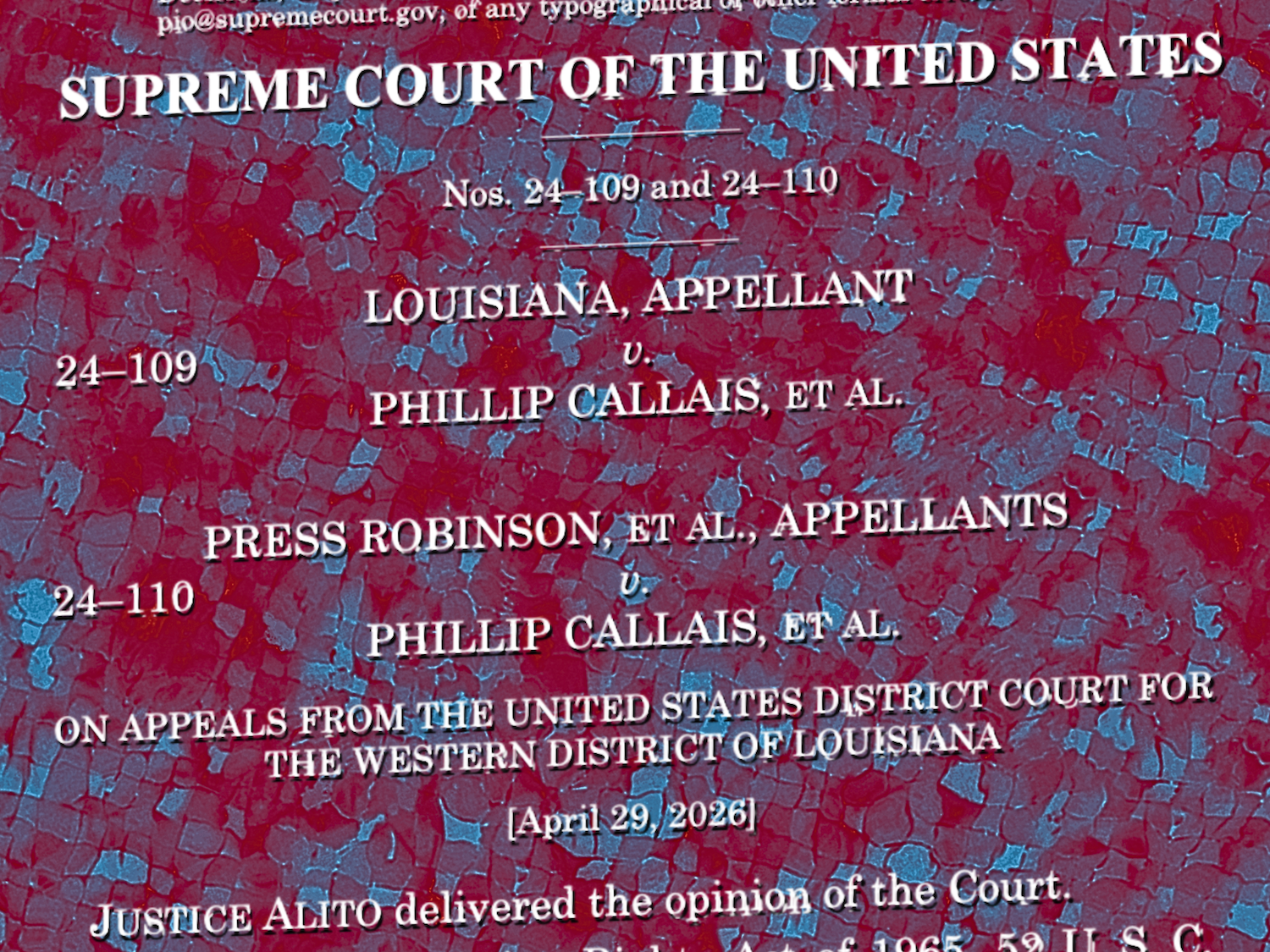
It has been just one month since the 6-3 conservative majority on the Supreme Court effectively nullified Section 2 of the Voting Rights Act (VRA), making it lawful for states to draw congressional districts that systematically dilute the votes of Black and Latino Americans. Within hours, Southern states responded. Florida legislators passed a GOP gerrymander the day the decision was announced. Alabama moved to eliminate majority-minority districts even after primary-election votes had been cast, though an appellate court has temporarily blocked the state from proceeding. South Carolina sought to gerrymander out of existence the district that has elected the state’s only Black congressman, civil rights icon James Clyburn. In Tennessee, the district representing Memphis—majority-Black—was cracked into three, all now majority-white, all expected to turn red.
Read more Aftermath: Something Is Going to Snap
One certain consequence of Louisiana v. Callais is widely recognized: Millions of voters of color will no longer be able to elect a representative of their choice, while Republicans will lock down an even larger share of congressional seats. But what’s at stake is far bigger: whether voters of color can elect legislators whose votes actually reflect their policy preferences. We know this because we examined nearly 20 years of congressional votes and the survey responses of more than half a million Black, Latino, Asian American, and white voters who were asked if they supported high-profile congressional bills, ranging from the authorization of the war in Iraq to the Affordable Care Act to the early COVID response.
What we found shows how much our democracy’s responsiveness has depended on the VRA—and how much will be lost without it.
As Memphis Goes, So Goes the South
Memphis bears witness to both the achievement and the reversal. For 19 years, one man has represented the majority-Black district encompassing Memphis. A progressive stalwart ranked the fifth most effective Democratic lawmaker in the House by the Center for Effective Lawmaking, he secured passage of the first formal congressional apology for slavery and brought home $69 million in community projects, including $3.15 million to restore the Historic Clayborn Temple—the organizing headquarters of the 1968 sanitation workers’ strike that brought Martin Luther King Jr. to Memphis for the last time.
The name of this revered member of Congress? Steve Cohen, a white Jewish civil rights lawyer. Tennessee Republicans did not gerrymander Memphis to remove a Black legislator. They did it to disempower Black voters.
Callais will have similarly devastating consequences for the substantive representation of voters of color throughout the South. It will not only reduce the chance that they have champions like Steve Cohen in Congress; it will also increase the chance that policies they oppose become law and policies they support don’t.
The figure below illustrates how representation in the House works today. Each dot represents a congressional district, with its position on the y-axis showing how well the average Black constituent is represented relative to the average white constituent in that same district. Values above zero mean Black Americans are better represented than white Americans; values below zero mean the opposite. The red and black curves trace the average relationship between this measure and the share of residents of each district who are Black, separately for non-Southern (red) and Southern (black) states.
Note how different the slopes of the lines are. Outside the South, Black Americans achieve representational parity with White Americans once they make up roughly 7 percent of a district’s population—a relatively low threshold that most districts can meet without race-conscious districting. In the South, however, Black Americans are systematically worse represented than white Americans when Black residents constitute less than about 40 percent of a district’s population. Put another way, in the very region where the VRA’s protections were most needed and most consequential, Black Americans require districts in which they make up a near-majority of voters before their preferences receive equal weight in Washington.
This is why the VRA has been so important. If Republican-controlled states throughout the South can now crack Black communities into districts where they constitute less than 40 percent of each district’s population, they can essentially silence Black voices in the region.
Party Matters
What makes the difference in districts with large Black populations? The answer is simple: They elect Democrats. Black Americans see their preferences reflected in their representative’s votes about 72 percent of the time when represented by a Democrat, but only 39 percent of the time when represented by a Republican. In other words, Black constituents lose a third more often on salient policy debates when the letter after a member of Congress’s name is an R rather than a D.
Black Americans are most affected by Callais, because of their concentration in the South and because of the grim history that helps explain that concentration. However, we find the same pattern for Latino and Asian American voters. Latino voters win on policy 66 percent of the time when represented by a Democrat compared with 45 percent when represented by a Republican. For Asian American voters, the win rates are 67 percent vs. 47 percent. For white constituents, by contrast, the gap is modest. And, in fact, they also do better when Democrats represent them—about three percentage points better, on average (58 percent vs. 55 percent).
This partisan effect is not entirely about Black, Latino, and Asian voters being more strongly Democratic, though that’s an important part of it. We find smaller but still significant effects when we take into account each voter’s party identification. When represented by a Republican, for example, Black Republicans are more poorly represented than are white Republicans. Indeed, even in so-called split delegations in the Senate, where one senator is a Democrat and the other a Republican, Democrats better represent voters of color, despite the fact that both senators are representing the same electorate overall.
For voters of color, then, who represents them is not just a matter of “identity politics.” It has direct, measurable consequences for whether their policy preferences are reflected in Washington. Cohen’s 19 years in Congress were 19 years in the 72 percent column for Black Memphians. The new Republican districts will put them in the 39 percent column.
This district-level story adds up. When we examine overall policy outcomes—whether voters of color get more of what they want from government—the partisan gap is stark. When Democrats control the presidency or Congress, and especially when they control both, Black, Latino, and Asian voters win on policy at least as often as white voters. When Republicans are in control, Black voters lose seven to nine percentage points more often than their white counterparts. Latino and Asian voters face similar gaps under Republican control, losing four to seven percentage points more often than white voters. Meanwhile, white voters’ overall win rates barely change regardless of which party controls government (though, of course, different white voters win in each case).
The upshot of all this is that racial gaps in overall policy responsiveness—whether the bills that citizens support become law—are surprisingly small. Aggregating our results across the nearly 20 years we examine, Black, Latino, Asian, and white voters all win just under half the time. Given that there’s actually a lot of agreement among these groups, this low level of congressional responsiveness to voters’ wishes—odds of winning slightly worse than a coin flip—offers a dismaying verdict on the capacity of our lawmaking system to do what citizens want. But it provides a reassuring verdict about the capacity of that system to equally respond to major racial and ethnic groups.
Or rather, it would if Democrats had an equal shot at winning power in the future. Our finding of relative equality hinges on the fact that Democrats controlled the presidency and Senate for more of the period we studied (2006 to 2022) than Republicans did. Remove the VRA’s guarantee of Democratic representation in majority-Black Southern districts, and that balance tips even more away from the public’s preferences.
Read more How California Politics Became So Blah
In the post-Callais world, Republicans can confidently do what they’re already doing in Alabama, Florida, and Tennessee—draw new lines that eliminate majority-minority districts and merge Black and Latino voters into majority-white, Republican-leaning districts. Cook Political Report estimates Republicans will net five to seven House seats from the redistricting wars of 2026—enough, potentially, to hold the House even in a difficult political environment for the GOP. And even if the blue wave is big enough to clear that wall in 2026, as widely forecast, Republicans expect to be able to lock in an even bigger advantage in future elections, particularly after new census numbers shift more congressional seats to states they control.
Specter of the Senate
What will that future look like? In her blistering dissent in Callais, Justice Elena Kagan declared that Section 2 is now “all but a dead letter” and predicted the consequences would be “far-reaching and grave.” Our research allows us to say exactly how far-reaching and grave those consequences could be. We can sum up our dismal forecast in two words: the Senate.
The Senate offers a sobering preview of what a world without VRA protections might look like. It’s a preview because even with the VRA in place there has been no redistricting in the Senate. State governments do not get to redraw their states’ borders. Because Senate constituencies are entire states, voters of color cannot be concentrated into majority-minority constituencies in the same way they have been in the House. And because states are usually much larger than districts, there are very few in which whites are not the largest group—and none of those states are in the South.
When it comes to the representation of voters of color in recent decades, the House and Senate look very different. The House has performed well on this metric—again, because of the VRA. The Senate, not so much. And the Senate is much more often decisive in the lawmaking process, given the supermajority threshold of the filibuster, so unequal representation there matters a lot.
The contrast for Black voters is particularly striking. They are not only less well represented by their senators than by their House members; their representation actually worsens as the Black share of a state’s population grows. Yes, the more Black voters there are in a state relative to white voters, the worse Black voters are represented relative to white voters. That’s the opposite of what democratic theory would predict, and it’s why Black voters are much more likely to be represented by Republican senators than by Republican House members. And all this is much more pronounced in South, where the majority of Black Americans live.
We are not certain why having a larger presence in a state causes Black Americans to receive worse Senate representation. But strong evidence points to a familiar suspect: racial resentment. Racial resentment describes prejudicial white attitudes that are more socially acceptable than unvarnished racism—for example, that Black Americans get special favors they don’t deserve. A huge body of research has studied these attitudes and how they’re activated by a sense of threat in places with large and growing racial “out-groups.” They’re also measured in many surveys, allowing us to develop precise measures of average racial resentment by state.
The figure below helps explain why larger Black populations generate poorer representation. There are two panels, one for the House (left) and one for the Senate (right). The y-axis is our familiar ratio of Black to white representation, with lower numbers indicating a greater imbalance in favor of white constituents. Finally, the x-axis in this chart is the average level of white racial resentment in the state. So the slopes of the lines show how this imbalance changes as the level of white racial resentment in a state or district increases.
And what becomes immediately clear is that the South and the Senate are distinct. In Southern House districts, the line slopes down—greater racial resentment, poorer Black representation—but not all that steeply. Now look at the Senate. Even outside the South, greater racial resentment produces poorer Black representation. But the line is much steeper, and racial resentment much higher on average, in the South. In Southern states with the highest racial resentment scores, Republican senators side with white constituents’ policy preferences roughly 20 percentage points more often than they do with Black constituents’.
Larger Black populations, it turns out, also generate greater white backlash, and that backlash appears to shape how Republican senators vote. In South Carolina, Rep. James Clyburn, long a fixture in both Southern Democratic politics and national Black politics, vowed last month, “No matter how the lines are drawn, where they are, I’m going to run for re-election.” But if his district is redrawn, we can expect the electorate he or his successor faces to look similar to the one that elected Republican Sen. Lindsey Graham. That electorate might elect a Black man—South Carolina’s second senator is Republican Tim Scott—but it is vanishingly unlikely to elect a Democrat. And that means Clyburn’s constituents will go from having a member of Congress whose votes put him well above the zero line to one who, like Scott as well as Graham, is well below it.
In the majority opinion in Callais, Justice Samuel Alito confidently proclaimed that “vast social change throughout the country and particularly in the South” has made the old VRA framework obsolete. Our data says otherwise. The South has changed enormously—because of the VRA, the civil rights movement, and decades of hard organizing. But the underlying dynamics that made the VRA necessary have not disappeared. And without it, Republicans can racially gerrymander new majority-white districts to make the House of the future look very much like the Senate of today.
Movement of the Moment
On May 15, Steve Cohen teared up as he announced he could not run again for the seat he’d held for nearly 20 years. He was not crying about losing office; he was crying about his constituents losing power. The sanitation workers who organized at the temple he’d helped restore had joined together to make their voices heard. The VRA helped translate that collective power into political representation—enough that a white Jewish congressman could spend two decades delivering for Black Tennesseans. Now that representation is being dismantled.
The protections of the VRA helped make American democracy more democratic. When Congress is less responsive to voters of color, it is less responsive to all Americans who share those voters’ preferences—on health care, wages, civil rights, and much more. Over the nearly two decades we studied, gains for Black, Latino, and Asian voters didn’t come at the expense of white voters. The periods when representation was more equal were periods of greater responsiveness to all racial groups. Representation is not a zero-sum game.
Restoring these protections will require that a responsive Congress end the partisan mapmaking that Callais has now made more dangerous. A national redistricting law establishing independent commissions would undo much of the damage—even if those commissions don’t take race into account. That’s because, according to careful analyses, compact districts that ensure roughly party-proportional outcomes will also ensure voters of color have a fair chance to elect representatives of their choice. Callais is not a blow for color blindness; it’s a blow against equal representation.
A proportional voting system would address the underlying structural problem more directly, though the road to its adoption is much steeper. And multimember districts that use ranked-choice voting or similar proportional representation rules would allow smaller groups sharing common interests, whether based on race or ethnicity or another common bond, to have a much better shot at gaining representation than they do in our current system.
Our research shows that the VRA propelled our nation’s progress toward political equality. Although that progress is now at risk, the fight to defend it is far from over. Three weeks after South Carolina Republicans moved to eliminate Clyburn’s district, organized resistance helped persuade the state Senate to reject the plan. The kind of mobilization that won the VRA in the first place will be needed to make equal representation possible again. Whatever the path forward, it should be illuminated by evidence about how representation really works as well as by the light of justice.
Read more Organized Money: Why Farmers and Filmmakers Both Face Monopoly