
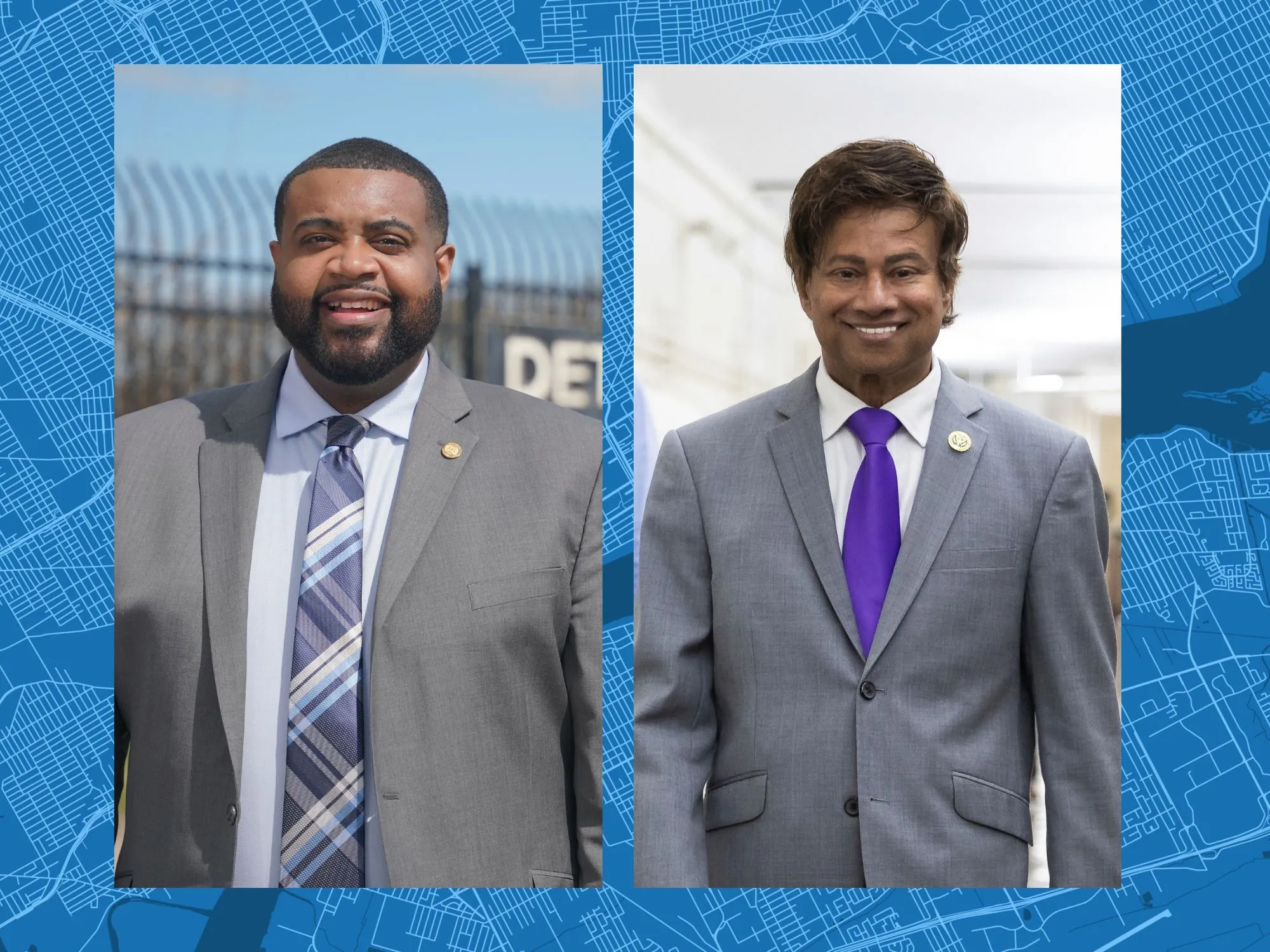
The latest battle between the Democratic Party’s insurgent left flank and moderate incumbents in Congress may also be the strangest of the cycle. In Michigan’s 13th Congressional District, progressive state lawmaker Donavan McKinney is challenging Rep. Shri Thanedar, a two-term congressman and former pharma executive. When he first ran for office eight years ago in a gubernatorial primary that featured Gov. Gretchen Whitmer and Senate-hopeful Abdul El-Sayed, Thanedar couldn’t decide whether to run as a Republican or an independent, before deciding on presenting as a “fiscally savvy Bernie” progressive. He burned through $10 million of his own cash, only to get dogged by allegations that he abandoned hundreds of beagles and monkeys at a drug-testing lab he once owned, a scandal that has been resurrected this year.
Read more Ida B. Wells: Brave Woman
Thanedar lost that election badly, but the experience wasn’t all for naught. He had won in Detroit, where he later moved and now represents in Congress. In the interim, he’s been sued for business fraud (he settled), joined and left the Democratic Socialists of America, courted pro-Israel and pro-crypto groups, infuriated Democratic leadership by spearheading “rogue” impeachment proceedings against Trump, churned through congressional staff, and funneled millions of dollars of campaign cash into crypto and other investments.
Much of the race has been clouded by the national electoral environment after the Supreme Court’s Callais decision, which may erase more than a dozen majority-minority congressional districts, rolling back Black representation in the House. Michigan’s predominantly Black 13th Congressional district has not been represented by a Black congressmember since 2019.
Thanedar is still endorsed in this race by the top three members of the House Democratic leadership, but this week, McKinney, a progressive member of the Michigan House of Representatives and Parliamentarian for the body’s Black Caucus, secured the breakaway support of a key member of the Democratic establishment. Rep. Steven Horsford (D-NV), the immediate past chair of the Congressional Black Caucus (CBC) and a former vice chair of the Democratic Legislative Campaign Committee, endorsed McKinney on Monday.
Read: As the CBC condemns Will Lawrence, local Black leaders back him up
CBC leaders have invariably stood with incumbents and deferred to seniority because it’s historically been a way to retain influence within the Democratic caucus. But how to handle Thanedar, a wild card keeping the CBC from additional representation, has been wrenching and opened the group up to criticism. In a nearby district in Lansing, the CBC is spending close to $1 million in a primary without a Black candidate. Yet neither the CBC nor its current leader, Rep. Yvette Clarke (D-NY), has endorsed in this race, which is an opportunity to add a member representing a heavily Black district. The CBC did not respond to a request for comment.
As of the most recent polling, the candidates are neck-and-neck in the run-up to the August 4th primary, amid a profusion of spending from interest groups and by Thanedar himself. The crypto-backed super PAC Protect Progress has spent roughly $1.1 million to boost Thanedar, who has consistently voted for federal legislation the industry supports. The week immediately following the primary, Thanedar is slated to speak as a special guest at a crypto industry retreat on Martha’s Vineyard. Bundlers from the American Israel Public Affairs Committee (AIPAC) have also donated more than $100,000 to his campaign. But the bulk of the fundraising has come from millions of dollars Thanedar has personally loaned to his campaign––his committee, per its most recent filings, owes more than $13 million, accrued over the last three cycles––or reaped in profit from investments of campaign cash, including investments in crypto. One from last year showed Thanedar’s campaign made close to $2 million in investment income in a three-month period. Another the campaign lost as much investing later in the year in the same amount of time.
McKinney has pulled in hundreds of thousands of dollars in support from Justice Democrats, the progressive funders who have been backing left-wing challengers in Democratic primaries throughout the country and tapped McKinney as their first recruit this cycle. McKinney also has broad backing that includes both the Working Families Party and the Democratic Socialists of America, organizations that have recently been jockeying for influence in the Democratic Party, in addition to national and local unions like National Nurses United and the Michigan AFL-CIO.
In his effort to unseat a sitting member of Congress, McKinney has run in many ways like an incumbent. He’s been endorsed by the state’s lieutenant governor, the local county executive, former Michigan congressmembers Andy Levin and Brenda Lawrence, prospective colleague and sitting Michigan congressmember Rashida Tlaib and five other members of Congress, as well as half of the state senate’s Democratic delegation, nearly half of Democratic state reps, and a slew of local lawmakers and mayors. “Donavan has been able to pull together a coalition of legislators who would normally be in the corner of the incumbent because Shri has been so absent and alienated himself from so many elected officials in Detroit,” Ravi Mangla, press secretary for the Working Families Party, told the Prospect.
McKinney leaned into that message in his initial television ad in the district. “People like Shri Thanedar are the problem,” McKinney says in the ad. “He’s not like us.”
Thanedar and his campaign did not respond to multiple requests for comment.
It’s a different picture from six years ago, when these two candidates first faced off in a Democratic primary. Back in 2020, Thanedar and McKinney duked it out in a crowded race for Michigan’s third state house district, where the electorate at the time (before a more recent redistricting) 90 percent African American. Thanedar, the only non-Black major candidate in the race, eked out a victory with 35 percent of the vote after loaning himself more than $400,000. McKinney came in a distant second with about 20 percent of the vote. Al Williams, who placed fourth in the race, remembers the primary well. “Some people say he’s got more money than God,” he told the Prospect about Thanedar. “Running against him, he was willing to spend whatever he had to get there to get legislative experience. That’s what he wanted.”
After one term in the state house, Thanedar turned around in 2022 and self-financed a run for Michigan’s 13th Congressional District, which he again won in a crowded field with far less than a majority, this time under 30 percent of the vote. “Shri Thanedar beat me by 4,000 votes because there were seven other Black candidates in the race,” said Adam Hollier, a former state senator who ran in the primary to represent the plurality Black district.
Undeterred by Thanedar’s willingness to spend outlandish sums of his own fortune to win, Hollier had entered the primary with an enormous war chest thanks to the substantial backing of pro-Israel super PACs. Those groups had jumped into the race, incensed by Thanedar’s sponsorship of a 2021 state house resolution calling for a cessation of military aid to Israel, a position he’s since recanted. The following cycle, Thanedar, having consolidated the support of pro-Israel groups, won re-election more handily against Detroit city councilmember Mary Waters, who’s now running a write-in campaign with limited finances after missing the signature threshold to make it onto the ballot back in May. That raised some concern among Thanedar’s opponents that the incumbent could leg out another split-vote win, though Waters doesn’t see it that way. “There are plenty of votes for each candidate,” she told the Prospect. “People just need to choose the one that they want to support.”
Read more The Big Beautiful Bill’s Market-Based Health Care Delusion
Read: The Squad could have a new member in 2026
Horace Sheffield III, pastor of New Destiny Christian Fellowship in Detroit and long-time powerbroker in the city, who was one of Thanedar’s early backers in the district, is now among those worried about a split-vote outcome. He recently endorsed McKinney, but years ago he had supported Thanedar’s $10 million run for governor, and after that race pushed him to vie for a local seat in Detroit. “I identified for him that particular state district, [given] how well he had done,” he told the Prospect.
Sheffield has had misgivings since then. “The city of Detroit has a significant African American population. We enjoyed for 50 years the representation of two African Americans … Charles Diggs, and of course John Conyers, and now we’re down to none at all,” Sheffield said. “Donavan is aware of what’s going on in our community … and we don’t hear from the congressman at all.” Sheffield appeared with McKinney and a host of faith leaders and local officials at a church on Tuesday morning.
In his pitch to voters, McKinney has focused on his record in the state house, where he’s served since 2022, after stints as an organizer with the Service Employees International Union, representing Michigan nursing home and home health care workers, and on Gov. Whitmer’s Environmental Justice Council. As a member of the state house appropriations committee, he’s shepherded millions of state and federal funds to replace lead pipes in the Detroit area, finance local violence intervention programs, and build new public school facilities. He’s introduced legislation that would ban state-regulated utilities, which have held significant sway in Michigan politics and taken flak for dramatically hiking rates in recent years, contributing to campaigns, and lobbying elected officials. A version of that restriction will be on the statewide ballot this year.
On the campaign trail, McKinney has also stressed his upbringing in the community and his ability to understand its struggles, which include deep poverty, regular power outages, lead exposure, asthma, and a sense of abandonment by federal policymakers.
Should he make it to Congress, McKinney pledged to sign on to a slate of nationally significant bills backed by the party’s progressive wing, including the Block the Bombs Act, which would limit the sale of American-made offensive weapons to Israel, the EACH Act, which would allow federal health care plans to cover abortions, a Green New Deal, and Medicare for All.
Growing up, McKinney moved with his family 13 times, chased around the city by eviction notices. He developed asthma at a young age. He remembers attending meetings of the autoworkers union with his grandfather, before the local industry was hollowed out, and “just got a knack for it,” sending him into community organizing and a life in the labor movement. That bottom-up approach to politics is something he hopes the Democratic Party more broadly will heed beyond lip-service.
About a year before he was sworn in as a state lawmaker, McKinney found himself reckoning with the reality of living in Detroit in a way that Thanedar, who moved from Ann Arbor to a mansion in one of the wealthiest parts of the city, could not imagine.
McKinney’s first son had just been born, and when the family returned home, they found the neighborhood in the midst of an extended power outage, which have been chronic events in recent years. Last year, Michigan utility companies ranked dead last in a nationwide survey of power restoration times after blackouts. “We had to spend his first five days on the planet in a hotel room,” McKinney said. “I was able to fund it because I had a good job […] But you’ve got to think about the communities we represent. Right now as a state rep, I represent the poorest house district in Michigan.” The experience led him to draw up a policy intervention aiming at many problems at once, which he introduced earlier this year: a plan for community solar panel investments to backstop the power grid and bring energy costs down, while shifting to fossil-free alternatives.
“We’re at this stage and point in time where we still think we’re the party of the people, and so if we’re going to continue to claim to be the party of the people, well, we have to act like it,” McKinney told the Prospect. His constituents have expressed as much to him when they come to his district office looking for help. “Every few days, I’ve got seniors who have to make those tough decisions, ‘Should I use my little money I get every month to pay my rent or to pay for food so I can get through the day, or to pay for life-saving medicine so I can live,’” he said. “And I’ve got younger people in our communities that are working two, three jobs, not even making ends meet, let alone scraping by just to survive because the cost of living is skyrocketing because we’ve got an administration that wants to start war.”
“Half the battle is showing up,” McKinney said. “The other half is trying to figure out ways to bring home resources to improve the quality of life of the people we represent.”
Read more Organized Money: The Roll-Up of All Media Is No Longer Inevitable (with Adam Conover)