
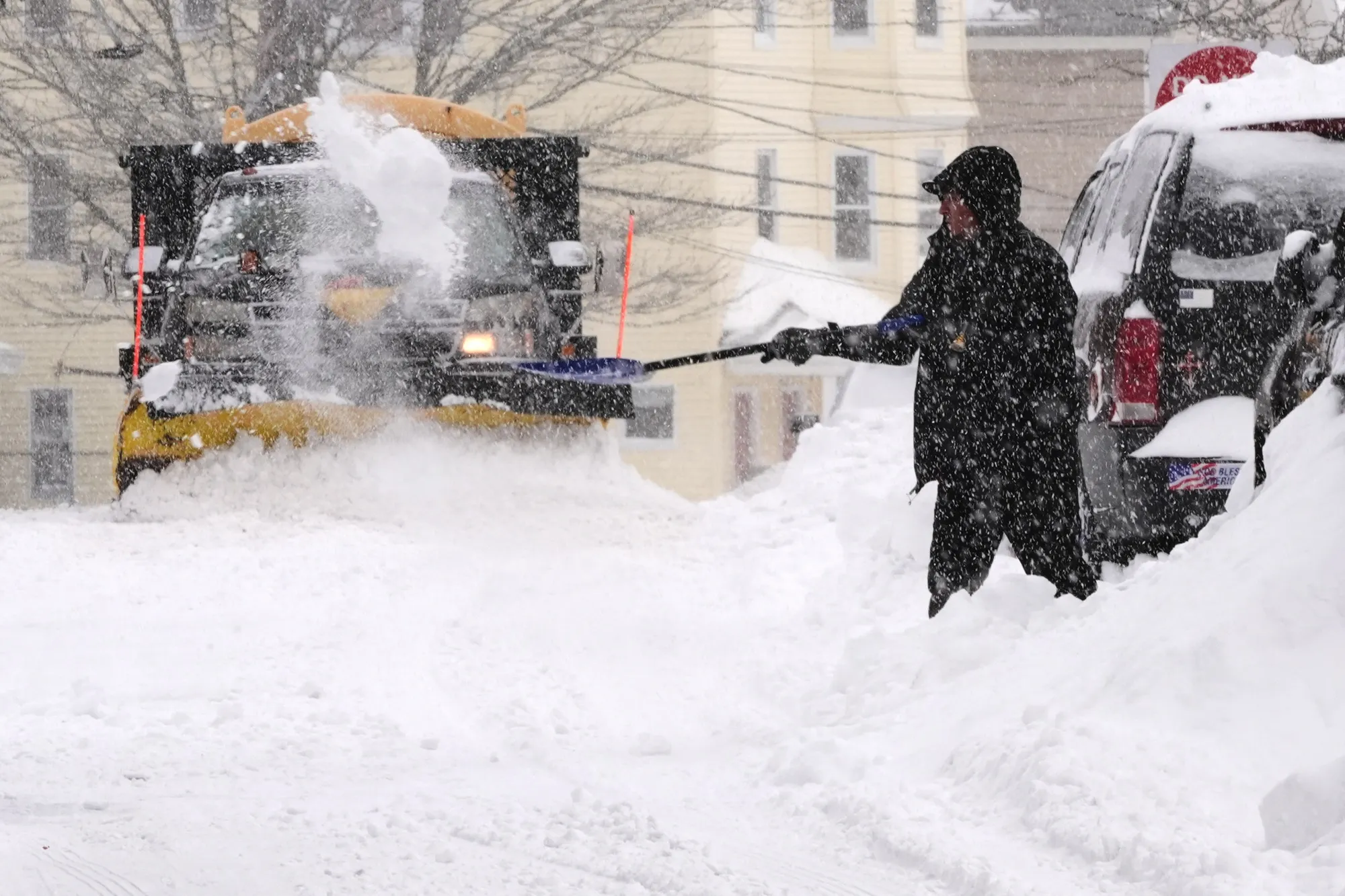
In mid-February, a fast-developing winter storm that had initially tracked off the northeastern Atlantic Coast made a turn toward land and exploded into bombogenesis, a bomb cyclone that dumped heavy snow on the mid-Atlantic and New England.
Read more A Great Economy Unless You Have to Work for a Living
Massachusetts and Rhode Island experienced the full force of the storm. Providence, Rhode Island, recorded a snowfall of nearly 40 inches in just 24 hours, with near-hurricane-force winds. The blizzard set a for the most snowfall ever in state history, surpassing the region’s legendary Blizzard of 1978. Two people died, and tens of thousands of people were left without power. Massachusetts was also hard-hit, while New York and New Jersey had their own snowpocalypses.
More from Gabrielle Gurley
What’s historic is left to meteorologists. For federal disaster assistance, there’s a stone-cold bureaucratic formula. Each state submitted a major disaster declaration request to FEMA. The agency uses a per capita formula, $1.94 times the state’s population, to calculate the request. New York requested $79 million; Massachusetts, nearly $45 million; New Jersey, $84 million. Rhode Island requested $19 million. Even so, all four of these Democratic trifectas received denials.
The administration’s quest to pare back FEMA’s role and speedily turn disaster management into a state and local function with minimal federal assistance has reached peak implementation—and Democratic states are bearing the brunt of those goals. Politico has reported that, of the disaster assistance requests by states with governors and senators of the same party, Republican states had 89 percent of their requests approved, while in Democratic states only 23 percent of their requests were granted. The Associated Press has reported that FEMA is also taking longer to respond to requests.
“In all four [Northeastern] states, FEMA documented damages that exceeded the threshold that the states needed to qualify for federal disasters by many multiples,” says Kenny Stancil, a Revolving Door Project deputy research director. He has also found that winter/snow-related requests are more likely to be rejected than ones related to flooding, tornadoes/wind, and tropical storms.
The Revolving Door Project, a Prospect partner that scrutinizes the executive branch, tracks major disaster declaration aid denials and delays. The watchdog group has found that of 27 major disaster declaration requests due to extreme weather, the Trump administration has rejected 17 from Democratic states, five from GOP states, and five from tribal governments.
“These rejections provide more evidence that Trump has transformed disaster relief into a political weapon and he’s wielding that against his perceived adversaries,” says Stancil.
BOTH PROJECT 2025 and the FEMA Review Council, a Trump administration group tasked with charting a reform mission for an agency that has faced underfunding and other challenges, proposed new formulas for calculating how much states and communities should receive for major disaster declarations. Their goal is for states and localities to do the heavy lifting for everything other than the catastrophic events that FEMA will handle.
Americans experiencing natural disasters have a love-hate relationship with the agency. Tales of red tape, slow-rolling assists, and other bureaucratic snafus are legion. But FEMA remains the one federal agency people count on to show up with muscle and money. The FEMA Review Council’s final report, published in May, underlines that this traditional understanding of FEMA’s role is on its way out.
The successor that in the next two to three years, the agency aims to reverse the expectation that the federal government is always going to come to the rescue if a state has an event that falls short of a catastrophe like Hurricane Katrina.
Federal support then becomes nebulous. Noting that states and local governments have primary responsibility to respond to hazards, the report states that “the federal government should retain the responsibility to support these efforts when required.” Meaning? “Federal assistance should only be reserved for truly significant events that exceed SLTT [state, local, tribal, and territorial] capacity and capability.”
Read more How America Let Its Workers’ Compensation System Fail
What the administration wants is a minimalist FEMA: an almost exclusive reliance on state, local, tribal, and territorial governments, along with a thick coating of privatized self-reliance. “We encourage every American to review their insurance policies and personal disaster plans,” the plan recommends, “as well as engaging with their local community leaders to be better prepared when disaster strikes.”
Last year, Cameron Hamilton, the once and likely future FEMA administrator, in a memo to an Office of Management and Budget official that major disaster declarations for snowstorms should be denied outright to reduce the costs as well as the total number of disasters requiring federal response. The memo also noted that the damage threshold that a state had to meet should be raised to four times the current per capita threshold. Hamilton’s nomination comes up for a Senate Homeland Security and Governmental Affairs Committee vote on Wednesday.
The focus on snowstorms led the Senate Appropriations Committee to in a 2026 Homeland Security appropriations bill overview that snowstorms should get disaster aid. “A major disaster declaration shall not be withheld simply due to that disaster’s classification as a snowstorm,” the Republican-controlled committee asserted.
Indeed, Democrats in cold climates aren’t the only ones being singled out for denials. Major disaster declarations are issued for entire states, not localities. Last fall, FEMA rejected a major disaster declaration for the two western Maryland counties in a region that voted overwhelmingly for Trump. The state, however, had not, and Gov. Wes Moore (D), a frequent Trump critic, said at the time that the president had “politicized disaster relief.”
After deep-red Arkansas failed to receive a major disaster declaration for counties hit by tornadoes and severe storms, the state appealed the decision. Gov. Sarah Huckabee Sanders (R) phoned Trump to make a personal bid for a reversal. FEMA granted the appeal. “I had a productive conversation with the President in which he expressed his support for our state,” Sanders said in a statement, “and I offered my full endorsement of his plans to reform FEMA to save money and provide greater direct assistance to disaster victims.”
RHODE ISLAND GOV. DANIEL MCKEE (D) FEMA’s rejection two days before the nation’s 250th anniversary. The agency didn’t give a reason. The congressional delegation’s response on the eve of the Fourth would have lit up the skies over Providence in infuriated hues:
“We write to demand you immediately reverse the July 2, 2026 denial of the State of Rhode Island’s request for a major disaster declaration under the Stafford Disaster Relief and Emergency Assistance Act for its historic February 2026 blizzard,” the response read. “After months of waiting, on the same day you approved major disaster declarations for several Republican-led states, you chose to leave Rhode Islanders out in the cold. It is unacceptable to politicize the disaster declaration process when Rhode Islanders’ health, safety, and businesses were severely impacted by this historic storm.”
Two weeks before the Northeastern states’ denials, Sens. Andy Kim (D-NJ), Gary Peters (D-MI), and 15 colleagues contacted OMB Director Russell Vought detailed information about FEMA processes “given the significant partisan disparity in President Trump’s approval of disaster declarations and related federal disaster relief funds.” (The OMB responded by directing Kim’s office to the agency.)
What’s lost in the nasty partisan warfare is that no state—Democratic or Republican—has the financial resources to handle the increasing numbers of major snowstorms, floods, hurricanes, tornadoes, and wildfires without federal assistance—and especially not during the years when the Trump administration has flipped even more costs back to state, local, tribal, and territorial governments. “Devolution is a bad idea likely to exacerbate existing injustices,” says Stancil. “It probably means slashing school budgets and taking funding away from other essential public services.”
Rhode Island, Massachusetts, New Jersey, and New York have each appealed their FEMA denials.
Read more The Crisis of Care Work