
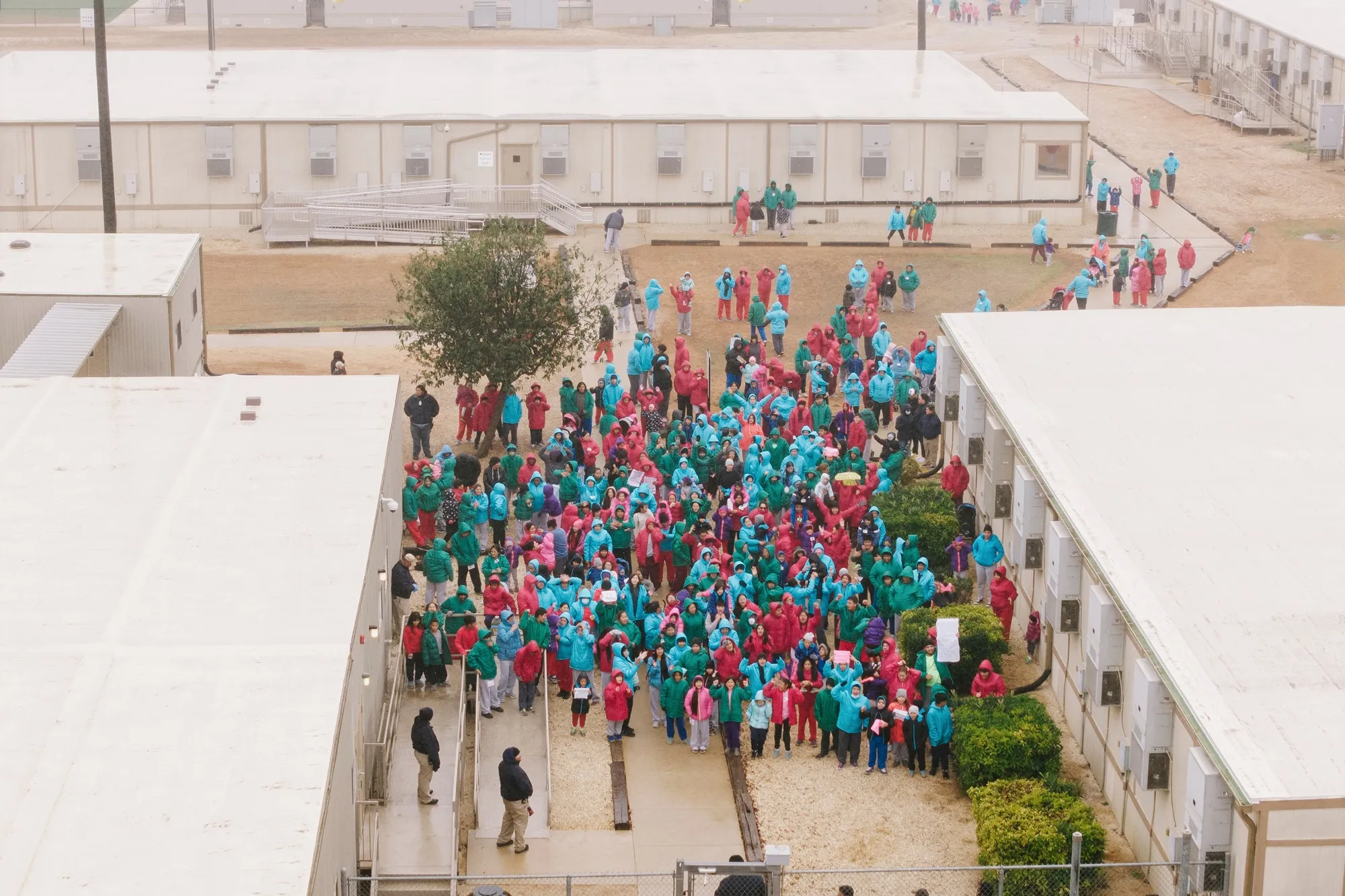
Trump’s Department of Homeland Security is imprisoning hundreds of immigrant children at the South Texas Family Residential Center in Dilley, Texas, for well over the legal limit of 20 days, including some for as many as 323 days, according to a .
Read more Jackson Earns Senate Nomination Sweep
The brief also offers more firsthand accounts of the abuse guards are inflicting on children in Dilley, run by private prison company CoreCivic, adding to the pile of evidence that Trump’s mass deportation campaign is systematically traumatizing children as young as infants, in some cases causing them to regress developmentally. Testimonies included in the brief include instances of guards denying children medical care, providing inadequate education, constantly screaming at them when they attempt to play, and in some cases, attacking their physical well-being, like tearing up their drawings and then shoving them when they object and repeatedly startling them awake during the night.
More from Whitney Curry Wimbish
In one instance, a male cleaning staff member repeatedly entered a women’s bathroom when he knew teenage girls were inside, naked and showering. In that instance, the girls’ mother submitted a grievance. But it was the girls who were the ones who paid for that complaint, as an official forced them to undergo a physical and mental examination.
A CoreCivic spokesperson failed to respond to an email seeking comment.
Plaintiffs filed the brief on July 15 in the U.S. District Court for the Central District of California against acting Attorney General Todd Blanche. They allege ongoing and extreme violations of the Flores agreement, which established almost 30 years ago that children may not be held in immigrant prison for more than 20 days unless the facility is nonsecure and licensed. Court filings have repeatedly claimed that Immigration and Customs Enforcement (ICE) is holding hundreds of children well beyond that. No length of time of imprisonment is appropriate for children, human rights advocates, attorneys, and doctors say.
The brief comes shortly after ICE published its hiding exactly how many children are at Dilley and how long they have been there. The report failed to disclose how many children were detained for 20 days or more over the last year, instead giving various monthly averages of the daily population and various monthly average lengths of imprisonment for children who have been released.
In May, ICE said children detained in February and March spent an average of almost 60 days in custody. In the annual report, however, it said the average length of stay was 47.5 days for February and 40.2 days for March. It claimed that the average length of stay from June 1, 2025, through May 31, 2026, was 27.4 days. ICE offered no explanation for the discrepancy, the brief says, and the plaintiffs also point out that any of those numbers exceed the number allowed under Flores.
Plaintiff site visits in March, April, and June found that some children were spending much more time in Dilley than ICE’s inconsistent averages assert. Among the longest stays they counted were families who had been detained for 323, 143, and 135 days. “During most site visits, the number of children experiencing exceptionally prolonged detention exceeded the number of families Plaintiffs’ counsel were able to interview,” the legal brief states.
Guards routinely abuse, neglect, and torment children at Dilley, the brief claims. In numerous first-person statements, children and parents describe ongoing retaliation for laughing and playing, as well as guards hurling racist abuse at them. One parent said guards “laugh at us and tell us to call Trump when we ask about the rules.” Another said they shouldn’t complain about the food because “If they were in their own countries, they would be eating shit.”
This ongoing abuse at the hands of guards contrasts with the government’s claim that the Dilley facility provides “family sessions, group sessions, psychoeducation, parenting education, and therapeutic or wellness-related programming such as Zumba and crochet,” as well as activities that include “bead bracelet making, jewelry box construction and decorating, birdhouse building, yarn weaving, crocheting, canvas painting, journaling, sports and game tournaments, relay races, hula hoop activities, tug-of-war, Zumba, karaoke, bingo, and chalk art.”
No family has ever reported receiving wellness-related programming “beyond brief check-ins,” the brief states, “and Plaintiffs’ counsel have never witnessed evidence of Zumba or crochet on any facility tour.”
In fact, wrote plaintiff’s attorney and Children’s Rights chief legal counsel Leecia Welch, when she asked parents whether Dilley offered Zumba classes, as the facility regularly advertises on tours, “they laughed at the suggestion.”
Parents said the abuse goes beyond deception about the lives children lead inside Dilley.
Read more Q&A: Family Vlogging: Good Times or Exploitation?
“Some of the guards are awful to the children. They are always screaming at kids for doing normal things like running at the park. If you’re at a park with kids, what do you expect they are going to do?” one parent said.
Another parent reported that all children have to do is watch TV. “There are no toys in the rooms. One day, my son and the other kids living in our room were playing with a ball that they made from rolling up paper. The boys were just playing and having fun. As soon as the guard heard the boys laughing, she came in and said they had to stop. That’s how it is here.”
In some instances, parents said, guards have taken specific aim to hurt children physically as well as emotionally. In one instance, a parent said officials found out she had spoken with reporters, so guards forced the family into lockdown and took away all her daughter’s coloring material. Later, one of the parent’s daughters wrote the word “liberty” on a piece of paper. Guards found it, threw it away, and then sent her to speak to a counselor, who interrogated her and then “reported” her.
When she returned to her room, there were 12 officials inside conducting a search. They found her children’s drawings and ripped them up, angering the older daughter. The interaction escalated when the older daughter confronted the guards and said not to rip up her favorite drawing of a telephone. This led one guard to push the older daughter, followed by all the guards in the room doing the same. “They pushed [my daughter] in the chest and grabbed her arm and she now has pain and bruises on her arm, and you can see swelling. They pushed me in my chest, too, and it still hurts,” the mother said. She added that the guards pulled out a camera and “started to record us and laugh.”
When she went to a counselor for support, “the counselor told me that they would revise the cameras, but did not do anything else,” she said.
Such physical harm is in addition to CoreCivic staff denying children medical attention or otherwise neglecting the safety of detainees, the brief claims, such as:
- Placing a two-month-old baby in isolation with his 15-month-old sister who had COVID and other illnesses, which led him to develop a respiratory illness.
- Giving a child with a severe tooth and gum infection a liquid diet for more than 20 days while the underlying infection persisted.
- Telling a child during a medical exam to come back in three days because they thought he was exaggerating his symptoms, when in fact he was suffering from appendicitis and needed to go to an emergency room.
- Failing to give a child with Hirschsprung’s disease the specialized treatment or diet she needed, “resulting in the child going 34 days without a bowel movement, and experiencing extreme pain, fevers, and vomiting.”
Children themselves provided details of the squalid conditions, inedible food, and contaminated water, all of which echo similar abuses prisoners have reported at other detention facilities. All is further evidence of the cruelty of child detention, which, as the brief points out, is completely unnecessary, especially given that ICE “has never submitted evidence demonstrating why any particular child posed a flight risk or safety concern,” the plaintiffs said.
“Imprisonment is permanently traumatizing to children—even after their release, they will bear lifelong physical and psychological scars,” said Sarah Kahn, senior staff attorney at the Center for Human Rights and Constitutional Law, one of the plaintiffs’ attorneys.
In many cases, children are eventually released because judges find they have a path to stay or because they cannot be removed, Kahn told the Prospect via email. “This underscores that these months of detention are not only arbitrary and senseless, but are designed to trap families in such inhumane conditions that many agree to relinquish their legal rights and leave the country.”
Children said they were worried about their families, and some of them said they were worried they’d never catch up at school and wondered if they’d ever get to go back.
“I have trouble sleeping because of all my racing thoughts,” one child said. “Will I go back to school? Will I go back to LA? Has my GPA gone down? I had a 4.0, and I was hoping to get scholarships. Now I don’t know what is going to happen.”
Read more Can Prime Minister Burnham Succeed?
Read the legal brief below: