
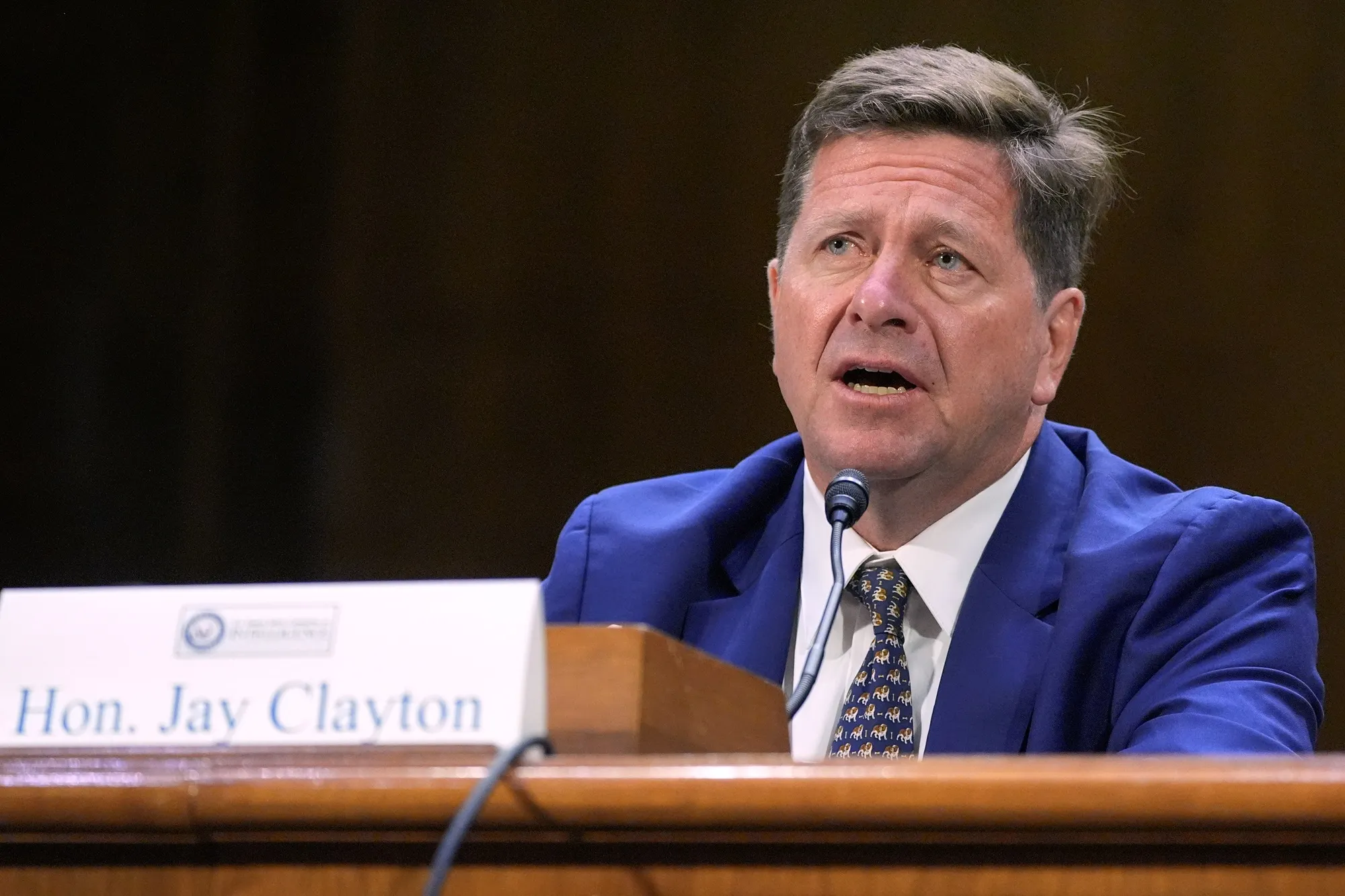
Unlike his previously scheduled testimony that was abandoned last month, Jay Clayton, the U.S. attorney in Manhattan whom President Trump nominated to succeed acting director of national intelligence (DNI) Bill Pulte, actually showed up for his long-awaited confirmation hearing on Wednesday.
Read more ICE Murders Continue
Clayton spoke at length about his qualifications for the top intelligence job to members of the Senate Select Committee on Intelligence. Between the range of national security matters he has handled as a prosecutor, and his experience advising the intelligence community in different capacities, Clayton articulated the depth of his “significant national security experience” with ease.
More from James Baratta
Yet the ostensibly respectable alternative to Pulte passed up every opportunity Senate Democrats gave him to say whether Joe Biden won the 2020 presidential election. “Isn’t it humiliating to be unable to answer this question, to have to indulge the president’s delusions?” asked Sen. Jon Ossoff (D-GA), who failed to get Clayton to make any legitimate response.
Following a similarly heated exchange, Sen. Mark Warner (D-VA), vice chair of the committee, seemed to lash out at Clayton over his failure to answer basic questions.
“I’ve known Mr. Clayton for some time … but I am bitterly disappointed,” Warner said. “We’ve tried umpteen different ways to give you the ability to just acknowledge that Joe Biden was the [fairly and duly elected] president.”
Clayton also deflected questions on process that led him to subpoena four New York Times journalists last week after they wrote a story that embarrassed the president. He said he was “not privy” to the Senate Intelligence Committee’s probe into whether Tulsi Gabbard interfered in domestic election activities during her tenure as DNI. And he suggested the Trump administration’s $1.8 billion anti-weaponization fund is “actually a pretty good deal for the government,” despite the fact that a federal court temporarily blocked its implementation last month and Todd Blanche, the acting attorney general who also had a confirmation hearing on Wednesday, admitted to senators that “the weaponization fund is dead.”
The reality is that, for all of the claims that Clayton is a saner, more acceptable DNI nominee than Pulte, the two share more in common than his supporters allow. Both of them lack real national security expertise, with Clayton being a corporate litigator, securities regulator, and enforcement attorney for his career. Both are fiercely loyal to the president, as shown by Clayton’s refusal to distance himself from the conspiracy theories surrounding the 2020 election, which Trump plans to amplify in a prime-time speech tonight. And both have shown plenty of willingness to go after Trump’s political enemies, a significant character flaw in a choice for any DNI, with reams of classified information at their disposal.
Of course, to the intelligence community and their allies in Congress backing Clayton—so many of them that the White House put together a page at its website to house all the plaudits—the relative merits of him versus Pulte are insignificant. Clayton is just a tool to get what they want: the reauthorization of Section 702 of the Foreign Intelligence Surveillance Act (FISA), which expired last month amid an impasse over warrantless surveillance of Americans.
Pulte, who has already used confidential mortgage information to assist vengeful prosecutions of Federal Reserve governor Lisa Cook, Sen. Adam Schiff (D-CA), and New York Attorney General Letitia James—none of which were successful—is a central-casting villain, someone that Democrats would be highly uncomfortable having in charge of a reauthorized spying program. Clayton, with his alleged credentials and ease in the halls of power, doesn’t read the same way, according to his backers. With him in place, Democrats would feel better about giving up on FISA reform and extending Section 702.
According to Hajar Hammado, policy adviser at Demand Progress, all of this boils down to the sense of urgency compelling intelligence hawks to “hand Trump a clean reauthorization of Section 702 as quickly as possible.”
That may have been a good strategy before Clayton weaponized the grand jury process last week, a key tell that he would reliably do the bidding of the president. Now, the best-laid plans of the intelligence hawks may go awry. Clayton may get confirmed—he only needs Republicans for that. But he may not fare any better in bringing Democrats along on FISA reauthorization.
The subpoenas for the Times journalists came after they published a story about potential security risks tied to the new Qatar-gifted Air Force One being used by President Trump. It was beyond clear that the subpoenas were a form of payback on orders from the White House. Moreover, Clayton’s U.S. attorney’s office may have flouted internal procedures in issuing the subpoenas.
Read more Trump Funding Cuts Endangering City and Rural Hospitals Alike
“The Department of Justice has internal guidelines known as the ‘News Media Guidelines’ that are supposed to limit these types of subpoenas,” said Caitlin Vogus, senior adviser for advocacy at the Freedom of the Press Foundation (FOPF). “The government is supposed to exhaust alternatives before it would subpoena the press, meaning it’s supposed to look for other ways to find the information that it says it wants, and with the timing here … it’s very hard to believe that that exhaustion requirement could have been met.”
Without revealing details, Clayton told senators that his office followed protocols “to protect the First Amendment, and protect the freedom of the press, and not result in intimidation of journalists,” and that his actions were the “least intrusive” means of uncovering who leaked the information. He would not say whether he was ordered by the White House to issue the subpoenas.
The Times is appealing the subpoenas. A hearing in the case was scheduled for Wednesday, the same day as Clayton’s confirmation hearing.
In Trump’s prime-time speech tonight, he will reportedly release declassified information about a foreign nation’s plans to interfere in the 2020 election, as a pretext for election interference in this year’s midterms. Clayton as director of national intelligence would be well positioned to run that strategy, critics believe. “That is exactly what Clayton would be point on,” said Eric Naing, communications director at Demand Progress.
A coalition of progressive civil society organizations led by Demand Progress to Democratic members of the Senate Intelligence Committee this week, urging them to oppose Clayton’s confirmation.
“The Committee need not speculate how Clayton would exercise the enormous powers of the federal government,” the letter explains, “he is demonstrating it now.”
The letter, which was signed by dozens of progressive organizations, points to Clayton’s repeated election skepticism and inability to state clearly basic facts about the 2020 outcome. He is also accused of “politicizing high-profile investigations such as alleged Epstein ties to Democrats,” the letter states. While at the Securities and Exchange Commission, Clayton rolled back whistleblower protections for outsiders alleging personal knowledge of fraud.
The range of progressive groups signing on to the letter, including Demand Progress and FOPF, shows the depth of concerns about Clayton, especially after recent events. That will make it harder to cross a 60-vote threshold in the Senate to pass FISA reauthorization.
“We’ve seen this so many times before,” Naing told the Prospect. “This administration will put up just the most objectionable clown, and everyone will be aghast, and then they’ll put up someone who is, on the surface, one degree less objectionable, and then Democrats will fold and [say] this person is acceptable, but the same end will be met where the government is weaponized against Trump’s political enemies.”
But that may not work this time, as Naing explained: “The fact that so many different stakeholders, from press freedom to civil rights groups in the broader progressive movement, have signed on to this [is] just a bright-red warning sign to Democrats to not hand Trump this massive political win on surveillance.”