
When Donald Trump won the 2024 election, many Russian nationalists celebrated. The support provided by the Biden administration would be ended, and Russia would be able to stomp on a helpless Ukraine. Vladimir Putin’s war on the Ukrainian people, which Russian forces have carried out in the areas they occupied, through mass murder, rape, and kidnapping of Ukrainian children, could continue apace to a full obliteration of the nation.
Read more Courts Keep Blocking Trump’s Moves Against the Right to Vote
Trump did indeed cut off aid to Ukraine. He and Vice President Vance hauled President Zelensky into the White House and berated him to his face. “You don’t have the cards,” blustered Trump.
More from Ryan Cooper
But a funny thing happened on the way to the inevitable Russian triumph: Ukraine started racking up victories. Europe stepped up to make up most of the funding gap caused by Trump’s stab in the back, and Ukraine’s domestic military industry matured enough that it could make up much of the munitions gap. Ukrainian leaders have reformed and strengthened their military units, while Russia’s are crumbling under stupendous casualties and corruption. And the Ukrainian economy is holding, while the Russian one is starting to pop rivets.
While it is far too soon to declare victory to be inevitable, Ukraine now has a decisive upper hand. It’s a remarkable underdog story.
A major aspect of this story is about drones and missiles. Ukrainian long-range precision missiles are not as good as American ones, but they are a lot cheaper, getting better fast, and critically, they do not come with American rules about where and how they can be used. Ukraine even developed a custom cruise missile, called the “Flamingo,” with a range of 3,000 kilometers, and an apparent cost of less than $1 million. The American Tomahawk, by contrast, costs about $2.5 million for just a 2,500-kilometer range, though it is more technically advanced.
But when it comes to drone manufacturing and especially operation, Ukraine is almost certainly the world leader. Fully 95 percent of Ukraine’s drones are now domestically manufactured—a staggering figure for a country that had only a tiny drone sector before the war—and Ukrainian drone operators are terrifyingly effective. Ukrainian firms now make so many that despite tens of thousands of drones being used up per month, there are enough left over for some exports. All sorts of nations, anxious that they are now behind the military curve, are beating a path to Kyiv, begging for training and buying up what drones are on the shelves—including the U.S., ironically.
Ukrainian forces have thereby repeatedly hit Russian forces and infrastructure, both near and (very) far. One particularly zany Mission: Impossible-esque scheme last year, in which small drones were hidden in wooden crates, shipped across the country by unsuspecting hired Russian drivers, and then used for simultaneous attacks on five different air bases thousands of miles apart, came off with barely a hitch, inflicting billions of dollars’ worth of damage on Russia’s fleet of irreplaceable strategic bombers.
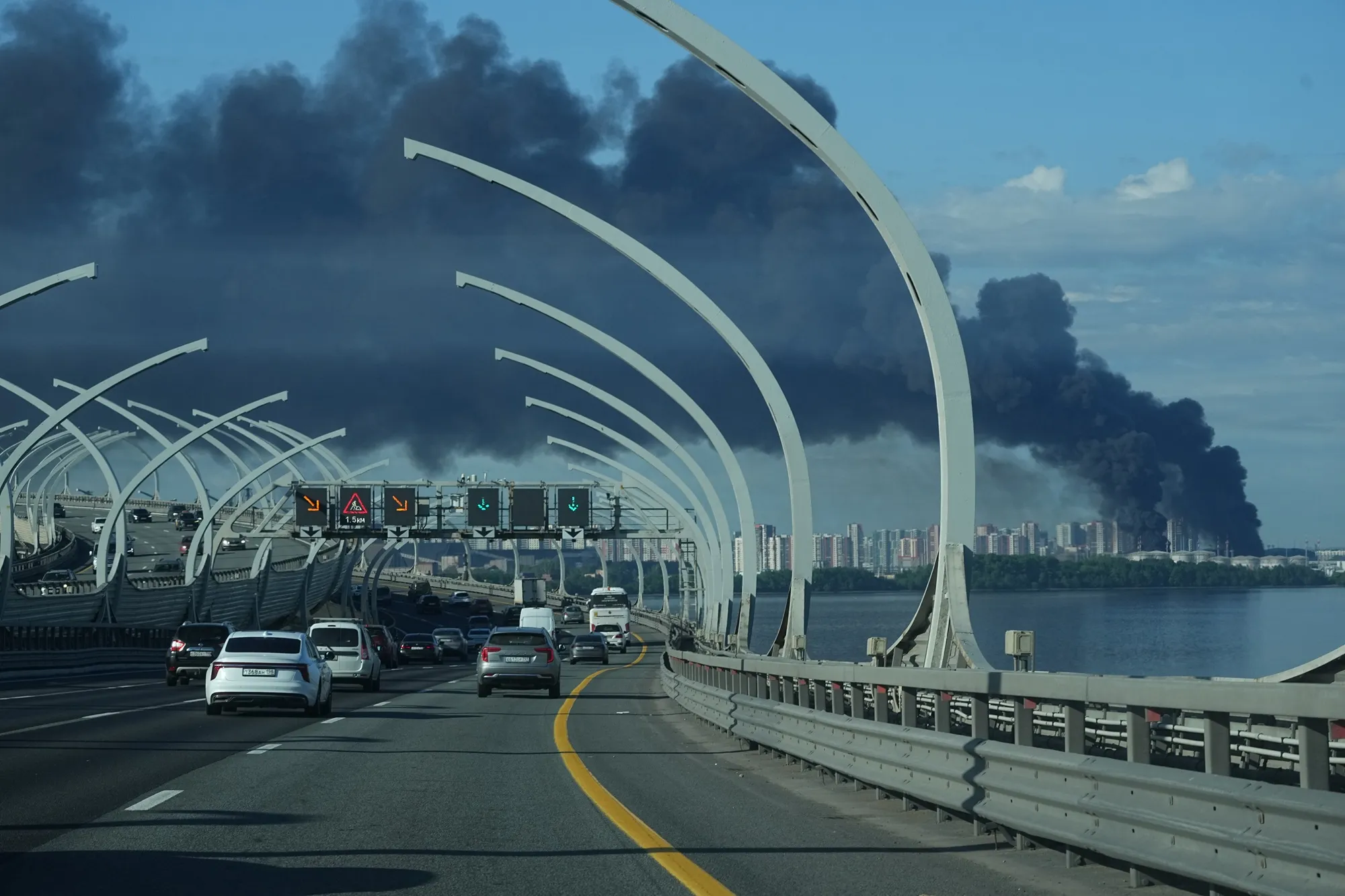
This year, the air campaign against Russia has stepped up a lot, and with much heavier ordnance. Ukraine has hit oil refineries, storage vessels, pipelines, factories, ships, and many other targets. Several Flamingo missiles were used in a successful recent attack on Cheboksary, about 600 miles from the Ukrainian border. Damage to the Russian oil industry seriously dented its ability to profit from the price increase caused by Trump’s war on Iran. Midrange drones have made the region behind Russian lines extremely dangerous, and badly tangled up its logistics.
Read more Billionaire Wealth Tax Headed to the California Ballot
Ukraine has even managed to hit Moscow, which is 300 miles from the Ukrainian border and has elaborate air defenses. On June 18, Ukrainian forces hit a major oil refinery on the outskirts of the city, and on June 26 they carried out the largest drone attack of the year so far, hitting targets from Moscow to Crimea. In the latter location, fuel is now critically short and the government has declared a state of emergency.
On the ground at the front lines, as Jack Watling writes at Foreign Affairs, while last year Ukraine was struggling with a chronic infantry shortage and an inability to rotate its troops off the front lines, it has since reorganized its structure and training system, and growing air dominance is allowing troops to get away for vital rest and recovery time.
Something of the opposite situation is taking hold on the Russian side, with undertrained recruits being slaughtered or deserting so quickly that it can’t stay ahead of the losses despite some 30,000 recruits per month. Corruption is also eating Russian forces from the inside. As the military analyst Perun points out, corruption can undermine military performance in many ways far beyond the obvious waste or theft of resources. For instance, when units bribe their commanders to skip out on an attack, or pretend to take a position by snapping a quick picture and running for it, commanders higher up the chain of command lose track of what is actually happening on the battlefield, and which forces are where. Morale and unit cohesion are undermined.
Finally, on the economic front, while the Ukrainian economy has been gravely battered, it is holding together thanks to grueling effort on the Ukrainian side and major support from the EU and U.K.
The Russian economy, by contrast, is coming unglued. The massive recruitment into Russian forces and massive casualties caused by constant reckless attacks—according to a NATO official, Russia has taken maybe 1.5 million casualties, a third of them deaths, which is not far from what it suffered in the First World War—have caused a major labor shortage. That plus immense war spending has made the economy severely overheated, with only 14.25 percent interest rates keeping a lid on inflation. And a whole lot of that war spending has gone into repairing and rebuilding the formerly huge stockpile of Soviet equipment left over from the Cold War that has since been mostly used up.
Incidentally, all this implies that the Biden administration’s nuanced support for Ukraine—which I’ll admit, I supported at the time—was far too timid and limited. If Ukraine had had full access to ATACMS long-range missiles in 2023, they could have inflicted untold damage with a surprise strike on Russian forces, who were seriously overstretched and vulnerable at the time. A no-holds-barred approach might have ended the war by now.
At any rate, this conflict is far from over. Vladimir Putin could attempt a full-scale war mobilization and bring Russia’s superior manpower and economic heft to bear. But this would create massive disruptions in Russian society and its economy. The labor shortage would get much worse, and inflation might get out of hand, touching off serious unrest. Putin claims he is a student of Russian history, and there surely is precedent for a dim-witted autocrat getting Russia stuck in a pointless, bloody, unwinnable quagmire of a war. It didn’t end well for Tsar Nicholas II. Hopefully, Putin will sue for peace before he risks sharing the same fate.